
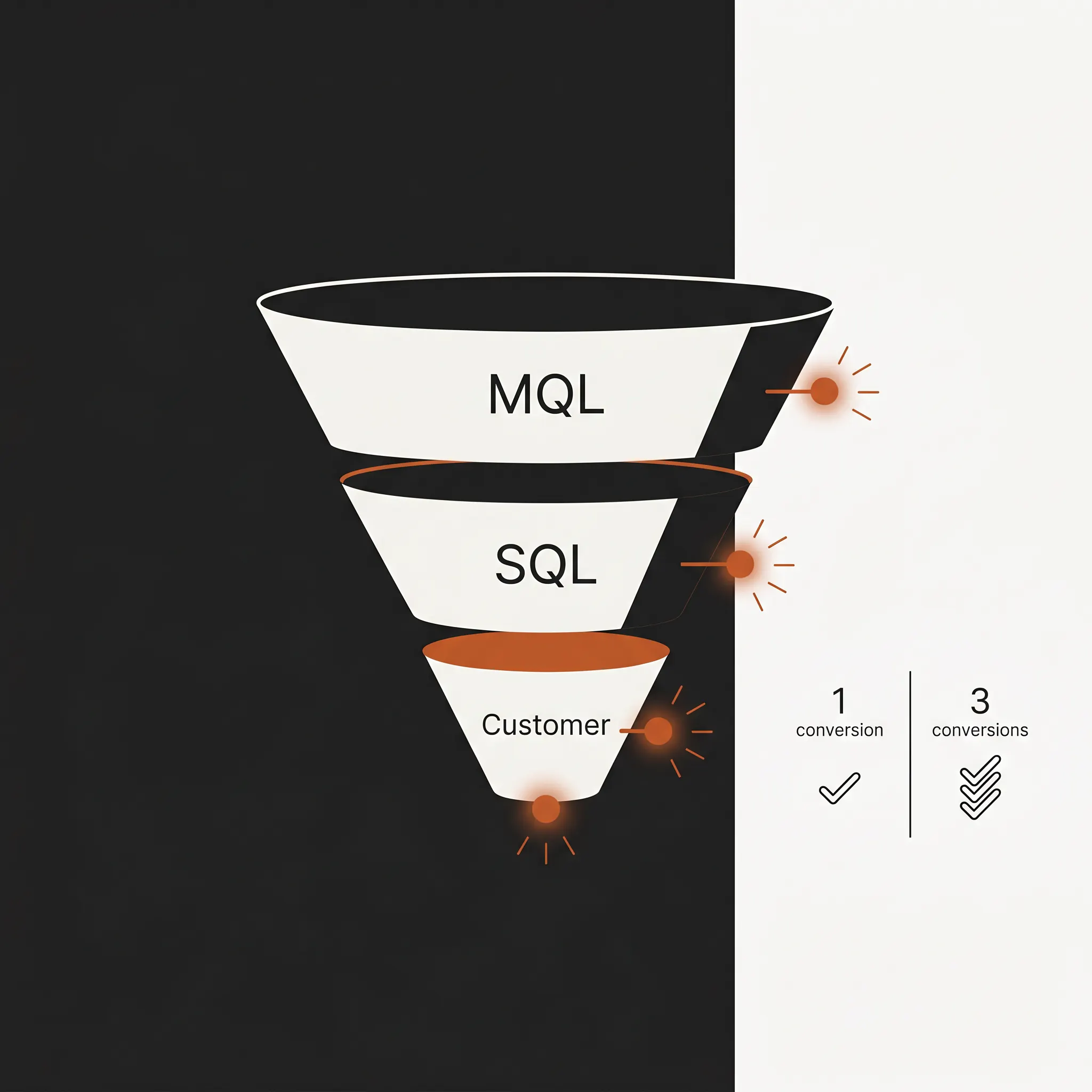
Google recommends optimizing for one account-default conversion goal. We spend $2M/mo doing the opposite, and it works. By firing a conversion event at every funnel stage (MQL, SQL, and closed customer) and weighting the deeper events higher, the algorithm learns from people who actually buy instead of people who just fill out a form. Here is the full setup.
What Google actually recommends
Google’s own conversion goals guidance is clear. If you have multiple standard conversion goals that track different stages of the same funnel, it recommends you set only one of them as the account-default goal. The logic is reasonable: one goal keeps the optimization signal clean and stops you from double-counting a single funnel.
For a simple account, that is fine advice. The problem shows up the moment lead quality matters more than lead volume, which for most B2B advertisers is always.
Why one conversion action goes blind
When you optimize for a single top-of-funnel action like a form fill, Google does exactly what you asked. It finds the cheapest people who will fill out a form. It has no idea which of those form fills becomes a customer, because you never told it. The same failure happens with phone leads, as shown in our Google Ads call tracking case study, where calls rose while first-time callers fell.
That is how accounts end up with a falling cost per lead and a rising cost per customer at the same time. The dashboard looks healthy while the business starves. A single conversion action keeps the signal clean, but it is blind to whether the lead is any good.
The setup: stack the whole funnel
Instead of one goal, we fire a conversion event at each stage a real buyer passes through.
| Funnel stage | Event fired | What it tells Google |
|---|---|---|
| Top | MQL | Someone raised a hand |
| Mid | SQL | Sales qualified them as real |
| Bottom | Customer | They actually bought |
A genuine buyer trips all three events on the way through. A dead-end form fill trips one. That difference is the entire point. If you are deciding which stage should steer bidding, use our framework for choosing the right Google Ads conversion action based on funnel depth and monthly volume. When you are ready to promote a deeper event, follow the safe conversion-action switch process so Smart Bidding can adapt without several campaign variables changing at once.
1. Track the whole funnel
Fire MQL, SQL, and customer events as distinct conversion actions. This only works if your tracking is solid end to end, which is why clean server-side conversion tracking has to come first. If the events do not reconcile with your CRM, stacking them just multiplies the error. Use our offline conversion tracking troubleshooting process before making a deeper action primary.
2. Weight the down-funnel events
A customer is worth far more than an MQL, so tell Google that by assigning higher conversion values to the deeper events. Without weighting, a high-volume form fill drowns out the rare customer event and you are back to optimizing for cheap clicks. Weighting is what keeps Smart Bidding pointed at revenue.
3. Learn from richer signal
With one action, maybe 100 conversions a month feed the model. Stacking the funnel pushes that closer to 150, and crucially that extra signal comes from people who actually became customers, not just people who submitted a form. More signal, and better signal, is what lets the algorithm find more buyers.
The tradeoff, stated honestly
This is not free. Stacking conversion actions adds tracking complexity and a real risk of mis-weighting, where a noisy mid-funnel event distorts bidding. That is exactly why Google’s default is one goal, and why you should not attempt this on an account with shaky measurement.
It pairs directly with cleaning the signal the other way too: retracting bad leads with negative conversions so the model stops chasing lookalikes of your junk. Adding good signal and removing bad signal are two halves of the same job. This whole approach is the foundation of how we scaled an account 4.6x while holding CPA under target: push the conversion signal as deep as the CRM allows.
The takeaway
Google’s one-goal recommendation is a safe default, not a ceiling. If you can track distinct funnel stages and weight them correctly, stacking MQL, SQL, and customer gives Smart Bidding a picture of who actually buys instead of who clicks cheapest. On accounts spending up to $2M/mo, that has been worth far more than keeping the signal simple.
If you want a team that builds conversion tracking deep enough to run this properly, TNT Growth manages full-stack Google Ads for brands spending $50k+/mo. See our results or book a call and we will map your funnel signal end to end.
Frequently asked questions
Should you use one or multiple conversion actions in Google Ads?
It depends on your funnel. Google recommends a single account-default goal to keep the signal clean, and that is safest for simple accounts. But if you can track distinct funnel stages like MQL, SQL, and customer, firing all three gives the algorithm richer signal about which clicks actually become buyers. We run multiple conversion actions on accounts spending up to $2M/mo.
Does adding more conversion actions hurt Smart Bidding?
Not if they are weighted correctly. The risk is that a high-volume, low-value event like a form fill drowns out the rare, valuable customer event. You avoid that by assigning higher conversion values to down-funnel events, so Smart Bidding optimizes toward the actions that represent real revenue rather than the cheapest one.
What conversion actions should a B2B account track?
Track the whole funnel: the lead or MQL, the qualified stage or SQL, and the closed customer. Fire an event at each stage and weight the deeper ones higher. This lets a real buyer count multiple times while a dead-end form fill counts once, so the algorithm learns to find buyers.
Why does Google recommend only one conversion goal?
A single account-default goal keeps the optimization signal simple and prevents accidentally double-counting stages of the same funnel. It is a sensible default for most advertisers. The tradeoff is that one goal is blind to lead quality, so accounts with real down-funnel tracking can outperform it by stacking and weighting multiple actions.