
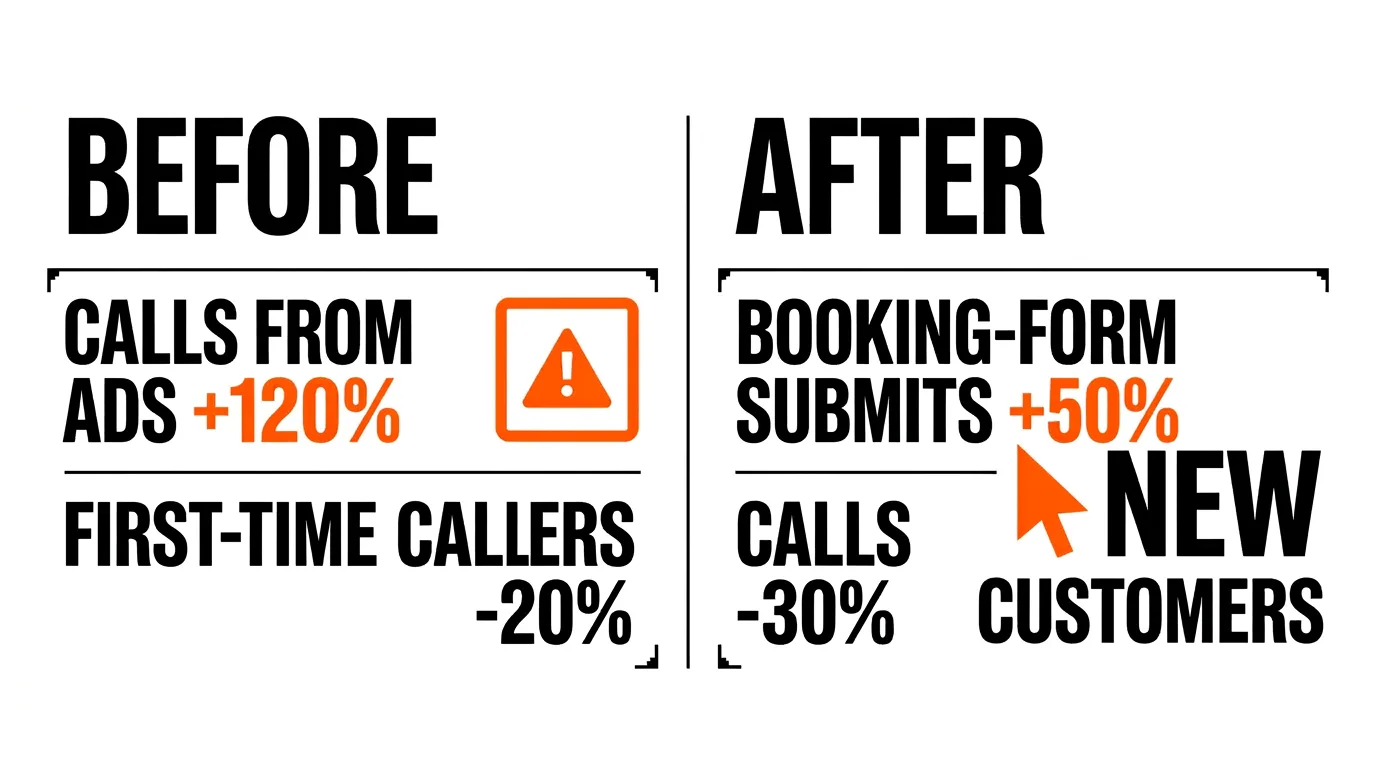
Google Ads call tracking fails when it rewards any phone call instead of a call from a potential new customer. In one scaled account, calls from ads rose 120% while first-time callers fell 20%. The fix was to stop bidding toward raw calls and make customer-linked actions, such as first-time callers and booking-form submits, the primary signal.
What is Google Ads call tracking?
Google Ads call tracking connects an ad interaction to a phone call. The basic setup can count calls made directly from an ad, calls to a forwarding number on a website, or clicks on call assets. A stronger setup imports the outcome of the call, such as a qualified lead, appointment, sale, or first-time customer.
Google documents several types of phone call conversion tracking. Calls from ads can use a Google forwarding number and a minimum call duration. Website calls can use a forwarding number inserted by a tracking tag. Imported call conversions connect call data from another system, usually a CRM or call tracking platform, to a valuable downstream action.
The last method is usually the most useful for scaled lead generation because duration alone does not tell you whether the caller was a new customer.
Why more calls can mean fewer customers
Smart Bidding optimizes toward the conversion actions you make primary. If Calls from ads is the easiest event in the goal, Google can increase that number without increasing new-customer acquisition. It may find repeat callers, route more mobile traffic into click-to-call, lean into brand demand, or count calls that last long enough but never become a qualified opportunity.
That is exactly what happened in this account:
| Metric | Change while scaling | What it revealed |
|---|---|---|
| Calls from ads | +120% | Google found more cheap calls |
| First-time callers | -20% | Fewer actual new prospects called |
| Reported CPL | Roughly on target | The dashboard hid the acquisition problem |
| New customers | Declining | CRM data contradicted platform performance |
The account looked healthy inside Google Ads. The CRM showed the opposite. This is why conversion tracking has to reconcile with business data before you trust the platform’s cost per lead.
The difference between a call and a valuable call
A phone call is a channel event. A valuable call is a business outcome. Those are not the same thing.
| Call event | What it proves | What it does not prove |
|---|---|---|
| Click on a call asset | Someone tapped the call button | The call connected or had intent |
| Call lasting 60 seconds | The conversation crossed a duration threshold | The caller was new, qualified, or bought |
| First-time caller | The phone number is not known in the system | The caller fits the offer or booked |
| Qualified call | The call met a documented sales rule | The lead became a customer |
| Booked appointment | The caller completed the intended next step | The person attended or purchased |
| Sale or admitted patient | The call produced revenue | Nothing deeper is needed for acquisition quality |
The deeper the event, the more useful it is for bidding. The tradeoff is volume. If sales occur only a few times per month, the event may be too sparse to steer a campaign alone. Our Google Ads conversion action framework explains how to balance depth against monthly volume.
The two-day fix we made
We did not change Target CPA, budgets, keywords, campaign structure, and conversion goals all at once. That would have hidden the cause. We changed the definition of success first.
1. Demote Calls from ads
We moved Calls from ads to a secondary objective and removed it from the account-default goal used for bidding. The event kept collecting data, so the team could still monitor call volume. It simply stopped telling Google that every cheap call was a win.
Google defines a secondary conversion action as observation-only in normal goal setups. It appears in All conversions but is not used for bidding. Check custom goals carefully because an action inside a custom goal can still steer bids even when the action is marked secondary.
2. Keep new-customer actions primary
We kept first-time callers and booking-form submits as primary actions because they were closer to real acquisition. A first-time caller filters out many repeat-service and existing-customer calls. A booking form reflects a person completing the intended next step.
Neither event is perfect. A first-time caller can still be a bad fit, and a booking can still no-show. But both are more useful than raw call volume for this account.
3. Hold bidding changes steady
We did not change Target CPA or switch bid strategies at the same time. If you change the signal and the bidding controls together, you cannot tell whether performance improved because Google learned a better outcome or because the auction strategy changed.
Google advises that Smart Bidding may need one to two conversion cycles after a conversion-goal change. Keep other major controls steady while the new event collects enough data.
4. Judge the outcome in the CRM
Within two days, booking-form submits increased 50% and calls decreased 30%. The lower call count was not a problem. It was the point. The account stopped chasing cheap calls and redirected spend toward actions linked more closely to new customers.
How to set up Google Ads call tracking correctly
A durable setup follows the call from ad interaction to business result. Healthcare teams should also audit the operational handoff using our guide to healthcare call tracking mistakes, including lost attribution, misrouting, workflow complexity, and privacy review.
Step 1: Choose the call sources you need
Google supports calls directly from ads, calls from website visits, and calls imported through uploads. Use the methods that match your actual customer journey. A local service advertiser may need both call assets and website calls. A B2B account with sales qualification needs CRM-linked imports.
Step 2: Enable call reporting and forwarding numbers
Calls from ads and many website-call setups rely on Google forwarding numbers. Call reporting records details such as call start time, duration, and caller area code. Google explains the requirements in its guide to measuring calls from ads.
Step 3: Capture the downstream outcome
Store the call in your CRM or call tracking platform and add the fields that matter:
- New or existing caller
- Connected or missed
- Qualified or disqualified
- Appointment booked
- Appointment attended
- Opportunity created
- Revenue or customer status
Write the definitions before automating the upload. If sales reps disagree on what qualified means, the imported signal will be noisy.
Step 4: Import qualified call conversions
Google’s phone call conversion import can match call details from your system to calls tied to ads. Import the downstream event you want Google to learn from, such as a qualified call or sale.
Be careful not to make the raw call and the imported qualified outcome primary when they represent the same phone call. Google warns that this can count two conversions for one call and cause bidding to value it twice.
Step 5: Set primary and secondary actions deliberately
Keep the action closest to new-customer acquisition primary, provided it has enough reliable volume. Move diagnostic events to secondary. Then inspect the campaign goal itself, not just the action label, to confirm which events actually steer bids.
Step 6: Reconcile Google Ads with the CRM
Every week, compare platform call conversions with first-time callers, qualified calls, appointments, customers, and revenue. A widening gap is an early warning that bidding is finding cheaper activity rather than better prospects.
Common Google Ads call tracking mistakes
Counting click-to-call as a customer action
A click is not a connected call. It can be accidental, abandoned, or unanswered. Use it as a diagnostic metric unless it reliably tracks qualified outcomes.
Using duration as the only quality filter
A long call can be a complaint, vendor, job seeker, or existing customer. Duration is better than a click, but it is still a rough proxy. Import the CRM outcome when possible.
Double-counting the same call
If Calls from ads and an imported qualified-call action both count the same conversation as primary, Smart Bidding may receive two wins for one person. Keep only the event that represents the intended outcome in the Conversions column.
Ignoring repeat callers and brand traffic
Existing customers often call after searching the brand. Those calls can be valuable for service, but they are not new acquisition. Segment first-time and repeat callers so paid media does not take credit for demand the business already owns.
Fixing every setting at once
Do not change goals, Target CPA, budgets, and structure on the same day. Make the conversion correction, wait through the relevant conversion cycle, and then decide whether bidding needs another change.
When raw calls should stay primary
Keep raw calls primary when a call is itself the completed business outcome, the account has no reliable deeper data yet, or call duration has been validated as a strong proxy for qualified demand. A small local business may need this temporary setup while CRM integration is built.
Even then, audit call details manually and set a duration threshold based on real sales calls. Do not accept the platform default without checking what happens after the phone rings.
What to do when call volume is too low
If qualified calls happen too rarely for stable bidding, do not drop back to the shallowest event by default. Combine a higher-volume event with the deeper action, assign values when they are credible, or keep more manual control until volume grows. Our guide to multiple conversion actions in Google Ads covers how to add signal without flattening every event into the same value.
The tracking foundation matters too. Capturing click IDs, connecting calls to CRM records, and sending outcomes back requires the same plumbing described in our server-side conversion tracking guide. Retract spam, duplicates, and disqualified calls with negative conversions so bad outcomes do not stay in the learning data.
The takeaway
Google Ads call tracking should measure calls that matter to the business, not every call Google can generate cheaply. Compare raw call volume with first-time callers, qualified calls, bookings, customers, and revenue. If calls rise while new customers fall, demote the raw event and move bidding toward the deepest reliable outcome with enough volume.
TNT Growth connects Google Ads to CRM and revenue data for brands spending $75k+/mo. Review our Google Ads and tracking services, see results measured beyond platform leads, or book a call to audit where your phone conversion signal is leaking.
Frequently asked questions
What is Google Ads call tracking?
Google Ads call tracking measures phone calls tied to ad interactions. It can track calls made directly from ads, calls from a number on your website, click-to-call actions, or qualified calls imported from a CRM. The useful version connects each call to a business outcome, not just a ring or a minimum duration.
Why can more Google Ads calls produce fewer customers?
Smart Bidding pursues the conversion action you make primary. If Calls from ads is primary, Google can find cheap mobile calls, repeat callers, and brand traffic without knowing whether those callers are new customers. Call volume can rise while first-time callers and sales fall because the bidding signal rewards the wrong outcome.
Should Calls from ads be a primary or secondary conversion?
Make Calls from ads secondary when raw call volume is not a reliable proxy for new-customer acquisition. Keep it primary only when the calls are consistently qualified or when you lack a deeper event and have verified that call volume tracks business results. A qualified-call or first-time-caller import is usually a better primary action.
How do you track qualified calls in Google Ads?
Use a call tracking platform or CRM to record caller details and the downstream outcome, such as first-time caller, qualified lead, appointment, or sale. Import that event into Google Ads through a phone call conversion upload or offline conversion process. Avoid counting both the raw call and imported outcome as primary if they represent the same call.
How long should you wait after changing a call conversion goal?
Hold other major bidding changes steady while the new event collects data. Google says Smart Bidding can need one to two conversion cycles after conversion-goal changes. The exact time depends on your sales cycle and volume, so judge the change on qualified calls, bookings, and new customers rather than raw calls alone.