
The right Google Ads conversion action is the deepest reliable event that still happens often enough for the campaign to learn. A closed deal is better than a form submit, but not if it fires three times a month. Balance signal quality with volume, then make the deepest event that clears your operating threshold the primary bidding goal.
What is a Google Ads conversion action?
A Google Ads conversion action is a specific event you want to measure, such as a form submit, phone call, qualified lead, subscription, or purchase. Conversion actions are grouped into goals. The actions used for bidding tell Google what success looks like, so choosing the wrong one can make a campaign look efficient while customer acquisition gets worse.
Google separates actions into primary and secondary conversion actions. Primary actions appear in the Conversions column and can steer bidding when their goal is selected. Secondary actions usually sit in All conversions for observation. One important exception is a custom goal: an action inside it can be used for bidding even if the action is marked secondary.
That is why this decision is not a reporting detail. It changes what Smart Bidding chases. Our study of Google Ads CPC by conversion depth shows why moving toward qualified or revenue events can raise click costs while improving the traffic mix.
Pick the deepest event with enough volume
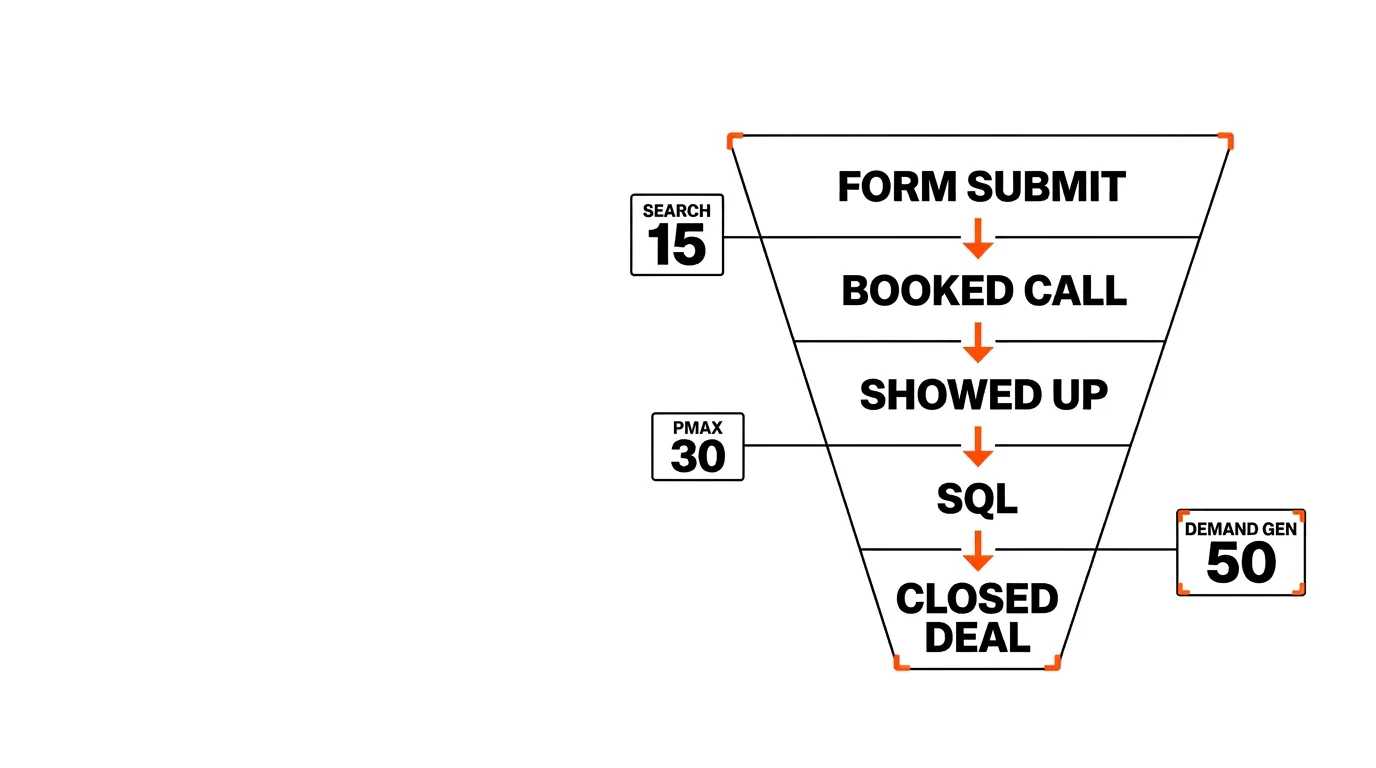
The useful rule is simple: move down the funnel until the next event becomes too rare to train the campaign consistently. Deeper events carry better business information. Higher events provide more data. Your job is to find the deepest point where both are still true.
| Conversion action | Signal quality | Typical volume | Main risk |
|---|---|---|---|
| Form submit | Low | High | Spam, students, vendors, and poor-fit leads count as wins |
| Booked call | Low to medium | High | No-shows and low-intent bookings train the model |
| Showed-up call | Medium to high | Medium | Requires CRM or scheduling feedback |
| Qualified lead or SQL | High | Medium to low | Sales definitions must be consistent |
| Closed deal or revenue | Highest | Low | Too little data for stable optimization in many B2B accounts |
The best event is not automatically the bottom row. It is the lowest row your account can support without starving the model.
Google Ads conversion action thresholds by campaign
These thresholds are TNT Growth operating guardrails from managing scaled accounts. They are not universal platform requirements or a promise of performance. Use them as a starting point, then adjust for your conversion cycle, market size, CPA, and data quality.
Search: about 15 conversions in 30 days
For Search, we want roughly 15 conversions in the past 30 days before asking Smart Bidding to make meaningful decisions around that event. Search starts with explicit query intent, so it can work with less volume than broader campaign types.
If the deepest event produces fewer than 15 conversions, either move one step up the funnel or keep more manual control. Do not force a sparse closed-deal signal into Target CPA just because closed revenue is the outcome you care about.
Performance Max: about 30 conversions per month
We generally want at least 30 monthly conversions before launching PMax against a conversion action. Performance Max can spend across Search, YouTube, Display, Discover, Gmail, and other inventory. That reach is useful only when the feedback signal is dense and clean.
When PMax receives a shallow event, it can find cheap volume that never becomes pipeline. We saw this when a campaign optimized for booked calls and produced spam. Moving the goal to people who actually showed up improved the signal. The full diagnostic is in our guide to fixing PMax spam leads.
Demand Gen: about 50 conversions per month
Demand Gen reaches people earlier than Search and works across broad visual inventory. We want about 50 monthly conversions before trusting it with a deeper optimization event. With less data, the campaign has too little feedback to separate real intent from cheap engagement.
If you have only 20 qualified leads per month, do not pretend Demand Gen has 50. Either use a higher-volume event with strong qualification controls or keep building volume in Search and PMax first. Our Google Demand Gen checklist covers the launch controls that matter once the signal is ready.
Target ROAS: value quality matters as much as count
Target ROAS requires conversion values that represent actual business differences. A form submit worth the same as a closed customer gives the bidder a meaningless value model. TNT’s operating floor is roughly 15 monthly conversions, but only when values are uploaded consistently at each stage. Use the Target CPA versus Target ROAS decision framework to check value variance, upload quality, and the starting target before switching bidders.
If values are guesses, stay with conversion-based bidding until finance, CRM, and ad-platform reporting reconcile.
Worked example: a high-volume healthcare account
Assume a healthcare advertiser produces these monthly outcomes:
| Funnel event | Monthly volume |
|---|---|
| Form submits | 600 |
| Booked calls | 200 |
| Showed-up calls | 90 |
| Closed patients | 25 |
The account runs Search and PMax. Closed patients are the best business outcome, but 25 is below the 30-conversion floor we use for PMax. Showed-up calls produce 90 monthly conversions, which gives PMax enough data and filters out the weakest bookings.
We would make showed-up calls the main optimization event, keep closed patients visible downstream, and consider adding closed patients as another primary action only if the tracking and value model are clean. We would also retract no-shows, spam, and disqualified leads quickly so the campaign does not keep learning from them. Google supports conversion adjustments and retractions, which is the technical basis for this cleanup loop.
Worked example: a high-ticket B2B SaaS account
Now assume a B2B SaaS company sells $100,000 contracts and generates:
| Funnel event | Monthly volume |
|---|---|
| Booked calls | 40 |
| SQLs | 12 |
| Closed deals | 3 |
Closed deals are too rare to run the account alone. SQLs are also below the 15-conversion floor we use for Search Smart Bidding. There are two defensible options.
First, keep manual CPC or a more controlled bidding setup while the account builds conversion history. Second, make booked calls and SQLs primary, then assign the SQL a stronger value so Google learns that not every booking is equal. This is the logic behind using multiple conversion actions in Google Ads: add useful signal without pretending a top-of-funnel event is the final outcome.
The wrong move is making booked calls the only success metric and celebrating a lower cost per booking while SQLs fall. A full-funnel marketing forecast keeps that mistake visible by projecting SQLs, customers, and revenue after the cohort has enough time to mature.
Common mistakes when choosing conversion actions
Making the highest-volume event primary by default
High volume feels safe, but form submits and click-to-call actions are often easy for Google to produce cheaply. If the action does not represent real intent, more data only teaches the model faster in the wrong direction. Our Google Ads call tracking case study shows calls rising 120% while first-time callers fell 20% because raw calls were the wrong primary signal.
Choosing the deepest event with almost no data
A three-deal monthly signal may be commercially meaningful but statistically thin. The campaign can swing after one delayed close, one large contract, or one tracking error. Keep the event, report on it, and feed it back, but do not assume it can steer every bid by itself.
Changing goals and bidding at the same time
When performance drops, teams often change the primary action, Target CPA, budget, and campaign structure together. Then nobody knows which change mattered. Google says Smart Bidding can need one to two conversion cycles after changes to goals or actions. Change the signal first, hold the other major controls steady, and let the new data bake.
Leaving sales definitions inconsistent
A qualified lead is only useful if sales applies the definition the same way every time. If one rep marks every conversation qualified and another waits for budget confirmation, the event is noisy. Write the qualification rule, audit it, and make the CRM field mandatory before sending it to Google. Then use the conversion-signal and match-type framework to decide how widely the campaign can target without sacrificing lead quality.
Forgetting primary, secondary, and custom-goal behavior
A dashboard can show an action without that action steering bids. The reverse can also happen inside a custom goal. Audit the campaign goal, action optimization setting, and Conversions column together. Never infer bidding behavior from the presence of a metric alone.
When not to move deeper
Do not move the primary action down the funnel when the CRM is incomplete, offline imports are failing, sales stages are inconsistently applied, the conversion cycle is longer than your reporting window, or the deeper event does not clear a workable volume floor. A deeper but unreliable signal is not better data.
Fix the measurement layer first. That means capturing the GCLID, connecting sessions to known users, mapping CRM stages, and importing the events back. Our server-side conversion tracking guide explains that foundation step by step.
How to choose your Google Ads conversion action
- List every measurable event from first touch to revenue.
- Pull the last 90 days of monthly volume for each event.
- Verify which events reconcile with your CRM or database.
- Remove events that are noisy, duplicated, or applied inconsistently.
- Compare the remaining volume with the campaign-type guardrail.
- Select the deepest event that clears the floor as primary.
- Keep deeper, lower-volume events for reporting, values, or added signal.
- Retract spam, no-shows, duplicates, and disqualified leads.
- Hold major bid and budget changes steady for one to two conversion cycles.
- Judge success on qualified pipeline and revenue, not the Google Ads conversion count alone.
Once the event is selected, use the conversion-action change process to test it as secondary, adjust the bid target, and evaluate complete cohorts without mixing other campaign changes into the result.
The takeaway
Choose the deepest conversion action your data can support, not the deepest event you can name. Search, PMax, and Demand Gen need different amounts of feedback. A showed-up call can beat a closed deal as the bidding signal when it produces enough volume and still represents real intent. Clean volume beats perfect but sparse data.
TNT Growth builds the tracking layer and runs Google Ads against downstream business outcomes for brands spending $75k+/mo. Review our Google Ads and tracking services, see client results tied to revenue, or book a call to map the right conversion action for your account.
Frequently asked questions
What is a Google Ads conversion action?
A Google Ads conversion action is a specific customer event you track, such as a form submit, booked call, qualified lead, or purchase. Primary actions can be used for bidding, while secondary actions are usually kept for observation and reporting. The action you make primary tells Smart Bidding what outcome to pursue.
Which conversion action should you use for Google Ads?
Use the deepest reliable funnel event that still produces enough monthly volume for the campaign to learn. A closed deal is higher quality than a booked call, but it can be too rare. In that case, use a higher-volume event such as a showed-up call or qualified lead as primary and keep closed deals visible for reporting or additional signal.
What is the difference between primary and secondary conversion actions?
Google defines primary conversion actions as events included in the Conversions column and used for bidding when their goal is selected. Secondary actions are normally observation-only and appear in All conversions. A secondary action inside a custom goal can still be used for bidding, so campaign goal settings need to be checked carefully.
How many conversions do you need for Smart Bidding?
There is no universal threshold that fits every account. TNT Growth uses practical operating floors based on campaign type and account experience: about 15 conversions in 30 days for Search Smart Bidding, 30 before launching PMax, and 50 before launching Demand Gen. These are operator guardrails, not guarantees from Google.
Should a high-ticket B2B account optimize for closed deals?
Only when closed deals happen often enough to create a stable signal. If a B2B account closes three deals per month, that event is usually too sparse to steer bidding alone. Keep manual control or optimize toward a higher-volume event such as booked calls plus SQLs, then use values and downstream reporting to preserve lead-quality context.