
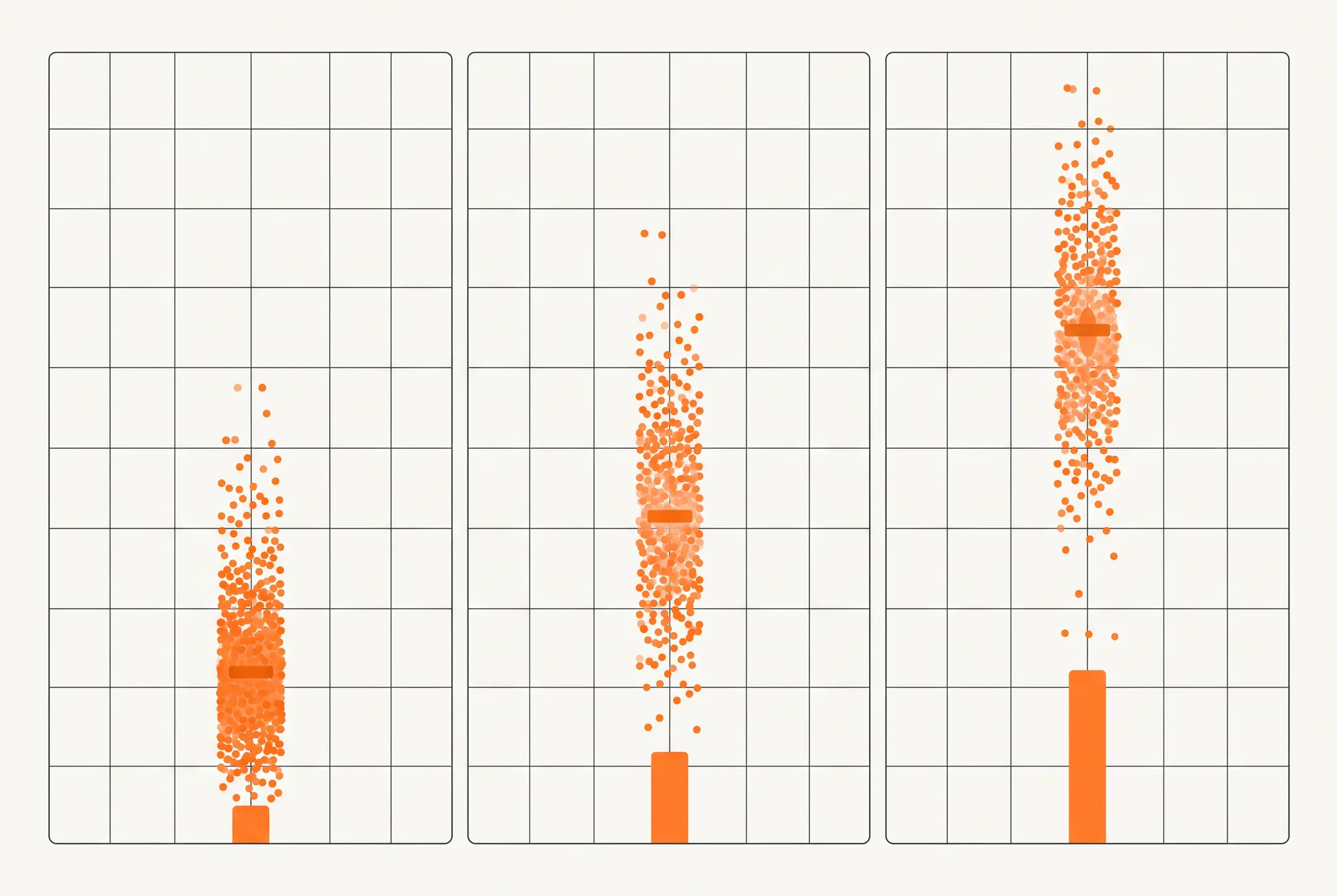
Google Ads CPC can increase when a campaign stops buying cheap clicks and starts competing for people more likely to become qualified leads or customers. In our analysis of more than 4,000 ads across 73 accounts, median CPC rose with conversion-event depth. That can be healthy, but only when downstream cost and revenue improve.
Google Ads CPC is a cost, not the business outcome
Google Ads CPC, or cost per click, is the average amount paid when someone clicks an ad. It is useful for diagnosing auction pressure and traffic mix. It does not tell you whether the click became a qualified lead, customer, or profitable sale.
A $1 click that never reaches sales is expensive. A $12 click that becomes a high-value customer can be cheap. The right question is not, “How do we get the lowest CPC?” It is, “How much can we pay for a click while still hitting our downstream acquisition target?” If query quality is weak, our guide to improving expected CTR in Google Ads shows how to tighten intent and ad specificity without chasing empty clicks.
That distinction matters because many account reviews treat a rising CPC as a failure before checking what changed in the conversion signal. When bidding moves from page views or form fills toward qualified leads and revenue, Google may enter fewer cheap auctions and pay more for clicks it predicts are more likely to produce the deeper event.
What our 4,000-ad Google Ads CPC study found
We pulled more than 4,000 Google ads from 73 accounts and grouped the accounts by the type of event their bid strategy optimized toward. We then compared the median CPC across three conversion-depth groups.
| Optimized event group | Example events | Median CPC |
|---|---|---|
| Shallow | Clicks, page views | $1.38 |
| Leads | Forms, calls | $3.48 |
| Deep | Qualified leads, customers, revenue | $6.65 |
The median CPC for deep-event accounts was about 4.8 times the shallow-event median. Lead-event accounts sat between the two.
This does not mean every advertiser should try to raise CPC. It means the cheapest click pool changes when the account asks for a rarer, more valuable result. The correct evaluation is whether the additional click cost buys better conversion quality and stronger unit economics.
The study’s limits matter
This was a cross-sectional analysis, not a controlled before-and-after experiment. The accounts optimizing for deep events also skewed toward healthcare and B2B categories where clicks can be expensive regardless of conversion setup. Only five accounts sat in the shallow-event group.
The analysis shows an association between event depth and CPC in our account mix. It does not prove that moving one campaign to a deeper event will cause its CPC to increase by a predictable amount. Industry, geography, query intent, competition, match type, bid target, landing page, and conversion history can all affect the result.
Use the finding as a warning against judging CPC in isolation, not as a universal benchmark.
Why deeper conversion events can raise Google Ads CPC
Deeper events can raise CPC because Smart Bidding is solving a different auction problem. A form fill is common and relatively easy to predict. A qualified opportunity or customer is rarer, more valuable, and often concentrated in more competitive searches.
Google explains that Smart Bidding calculates bids at auction time by predicting conversion probability and, for value-based strategies, probable conversion value. The campaign goal and the conversion actions included in bidding determine what the system tries to find.
1. The acceptable bid changes with conversion math
A simple ceiling for a click is:
Maximum CPC = acceptable conversion cost × click-to-conversion rate
Suppose a company can pay $100 for a lead and its landing page converts 3 percent of clicks into leads:
- $100 × 3% = $3 maximum CPC
Now suppose a qualified lead is worth an acceptable $600 and 1 percent of clicks become qualified:
- $600 × 1% = $6 maximum CPC
The deeper event converts at a lower rate, but its acceptable acquisition cost increases faster. That gives the bidder room to pay more for the right auction.
This is why a campaign can show a higher CPC while cost per qualified lead improves. The click costs more because the objective became more valuable.
2. Cheap clicks leave the traffic mix
Shallow conversion signals let the campaign buy people likely to click, browse, call briefly, or submit a low-friction form. Those actions can include students, vendors, job seekers, repeat customers, spam, and people who will never qualify.
When the campaign receives reliable qualified-lead or revenue data, it can stop entering some auctions that historically produced cheap but weak outcomes. Removing $0.40 clicks from the mix raises average CPC even when total acquisition economics improve.
Our guide to improving Google Ads lead quality explains how deeper conversion signals and match-type breadth work together. A broad campaign with a shallow form-fill goal has wide reach and a weak definition of success. A qualified-lead goal gives the same bidder a better filter.
3. Deep intent is more competitive
Queries tied to urgent, high-value outcomes usually attract serious competitors. A search from someone ready to book, buy, verify insurance, request an enterprise demo, or compare vendors can be worth more to every advertiser in the auction.
The clearing price rises when multiple companies recognize that value. Paying more is rational only if the account can convert and monetize the demand. An expensive click to a weak page or broken CRM is still waste.
When a higher Google Ads CPC is healthy
A higher CPC can be healthy when the campaign buys a stronger traffic mix and downstream performance holds or improves. The evidence should appear outside the CPC column.
| Signal | Healthy interpretation | Warning sign |
|---|---|---|
| Qualified conversion rate | Stable or rising | Raw leads rise while qualified rate falls |
| Cost per qualified lead | At or below target | CPC and qualified cost both climb |
| New-customer rate | More first-time buyers | Returning customers hide weak acquisition |
| Pipeline or revenue | Growing efficiently | Platform conversions rise without pipeline |
| Search terms | More commercial intent | Broader, irrelevant queries absorb spend |
| Conversion lag | Mature cohorts hold target | Recent incomplete data drives the conclusion |
A campaign with CPC rising from $4 to $7 can be improving if cost per qualified lead falls from $900 to $650. A campaign with CPC falling from $7 to $4 can be deteriorating if the cheaper traffic produces no opportunities.
This is why the primary dashboard should start with qualified conversions, customers, revenue, and acquisition cost. CPC belongs underneath as a diagnostic.
When high CPC is actually a problem
High CPC is a problem when the account pays more without receiving better intent, quality, or value. Common causes include stronger competition, a looser query mix, an unrealistic bid target, weak Ad Rank, poor landing-page conversion, or a conversion goal that does not represent the business outcome.
Check these conditions before accepting higher costs:
- The selected conversion action is trustworthy. Confirm the event is primary for the campaign, deduplicated, and reconciled with the CRM.
- The query mix still matches buyer intent. Review search terms and segment brand, non-brand, and competitor traffic.
- The landing page converts the new traffic. Higher-intent auctions do not fix a slow, unclear, or mismatched page.
- The reporting window is mature. A long sales cycle can make recent qualified CPA look worse before outcomes arrive.
- The bid target matches current economics. A target that ignores conversion delay or value can produce unstable auction behavior.
- The account is not paying for existing customers. Separate acquisition from repeat activity where possible.
Our Google Ads metrics guide covers conversion lag, new-customer reporting, impression share, and hidden search-term spend, all of which can explain a CPC change that the average column cannot.
How to evaluate a Google Ads CPC increase
Start with the business outcome and work backward. Do not lower bids on the first day CPC rises.
- Compare the current period with an equally mature prior period.
- Segment CPC by campaign, network, device, geography, match type, and brand status.
- Confirm whether the primary conversion goal or action changed.
- Reconcile Google conversions with qualified leads, opportunities, customers, and revenue.
- Calculate cost per qualified lead and customer acquisition cost.
- Review search terms for a shift in intent.
- Check conversion rate and message match on the landing page.
- Separate new from returning customers where the data supports it.
- Make one change tied to the diagnosed cause.
- Wait through the relevant conversion cycle before judging the result.
If the conversion action changed recently, Google recommends planning for a bidding transition. Its guidance on changing conversion goals used for Smart Bidding specifically covers moves from upper-funnel events to qualified leads, purchases, or other lower-funnel outcomes.
When not to optimize for a deeper event
Do not move bidding deeper when the event is too sparse, arrives inconsistently, or cannot be matched back to the ad click. A clean form event can be more useful than a qualified-lead event sales applies differently across reps.
Stay higher in the funnel while you fix:
- Missing GCLID or enhanced-conversion data
- Broken offline conversion imports
- Inconsistent qualification rules
- Duplicate or delayed CRM events
- Very low monthly conversion volume
- Revenue values that do not reconcile with finance
Use the Google Ads conversion action framework to pick the deepest event with enough volume. If the pipeline is not ready, our server-side conversion tracking guide covers click-ID capture, session stitching, database events, and platform uploads.
The takeaway
Google Ads CPC is not a score to minimize. It is an input into customer acquisition economics. Our 4,000-ad analysis found higher median CPCs in accounts optimizing toward qualified and revenue events, but the right conclusion is not “higher is always better.” The conclusion is that CPC needs downstream context.
A higher click cost can be healthy when cheap, low-intent traffic leaves the mix and qualified customer economics improve. It is a problem when cost rises without better conversion quality, pipeline, or revenue. Judge the click by what it becomes.
TNT Growth connects Google Ads to CRM and revenue data for brands spending $75K+/mo, then manages bidding against qualified business outcomes. Review our Google Ads and conversion tracking services, see client results measured beyond platform leads, or book a 30-minute ad audit to find out whether your CPC is buying better demand or just more expensive traffic.
Frequently asked questions
Why is my Google Ads CPC so high?
Google Ads CPC can rise because competition increased, targeting changed, Ad Rank shifted, or Smart Bidding began favoring clicks more likely to produce a valuable conversion. A higher CPC is not automatically bad. Compare cost per qualified lead, customer acquisition cost, conversion value, and revenue before deciding the account became less efficient.
What is a good CPC for Google Ads?
A good CPC is one that produces profitable customers at the required volume. There is no useful universal benchmark across industries, offers, and funnel stages. Work backward from conversion rate, acceptable cost per qualified conversion, close rate, and customer value to calculate what the account can afford per click.
Does optimizing for qualified leads increase CPC?
It can. In TNT Growth's cross-sectional analysis of more than 4,000 ads across 73 accounts, the median CPC was $1.38 for shallow events, $3.48 for lead events, and $6.65 for deep qualified or revenue events. The study shows association, not proof that changing the event alone caused the increase.
Should I lower bids when CPC increases?
Not until you know why CPC increased and whether downstream economics worsened. Lowering bids can remove the auctions most likely to produce qualified customers. First compare query mix, conversion-event settings, qualified conversion rate, cost per qualified lead, new-customer rate, revenue, and conversion lag.
How does Smart Bidding calculate a Google Ads bid?
Google says Smart Bidding predicts conversion probability or conversion value for each auction using contextual signals, then sets a bid based on the selected strategy and target. Target CPA focuses on conversion likelihood and cost, while value-based strategies also predict the value likely to come from a click.