
Landing page testing improves paid-media economics by comparing controlled page variations against a defined conversion goal. At Gusto, Adam Treboutat launched one meaningful test every two weeks. Over six months, visit-to-lead conversion rate moved from 2% to 8%. The same traffic produced four times more leads, which created room to scale spend without breaking acquisition cost.
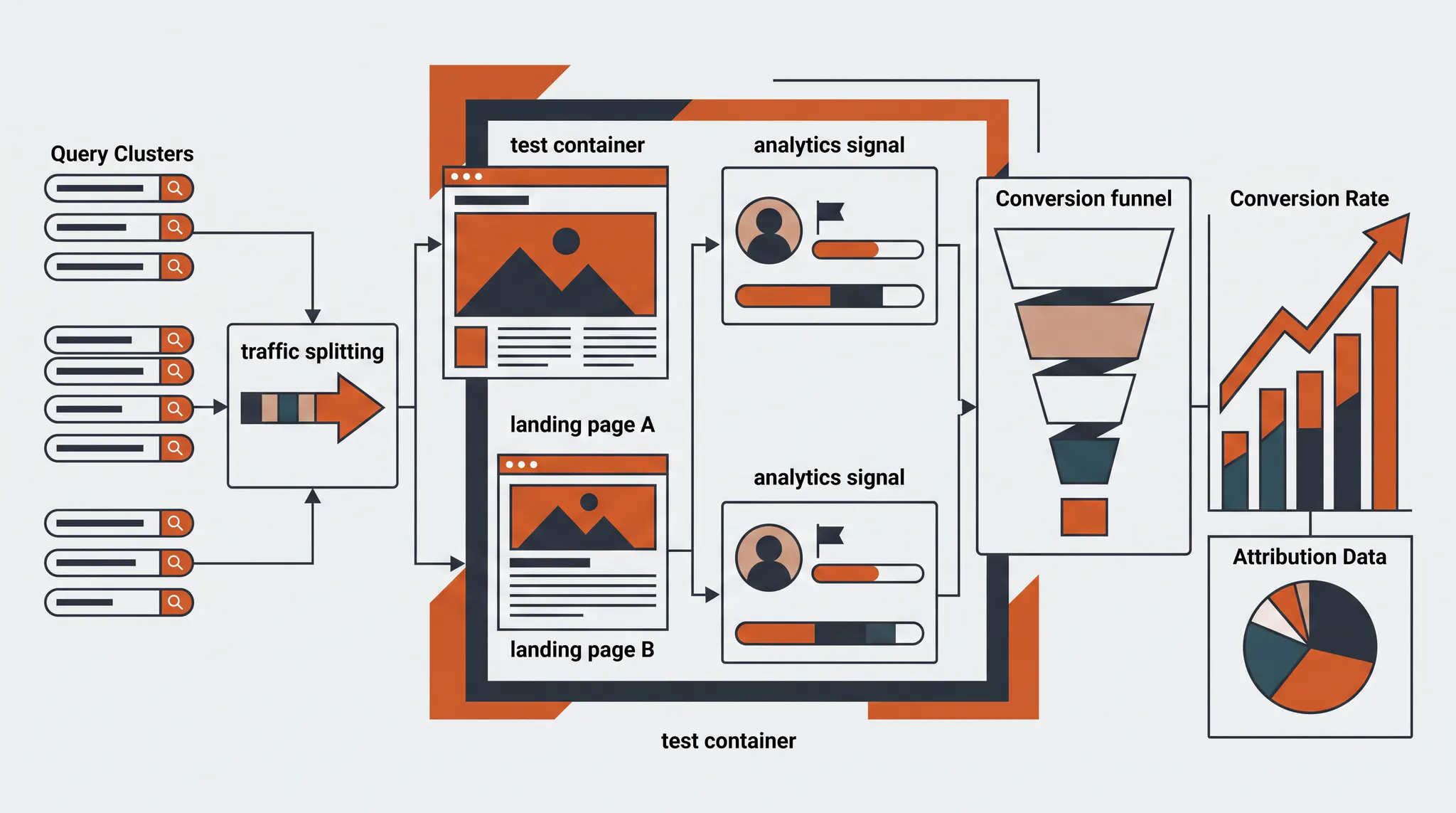
What landing page testing actually measures
Landing page testing measures whether a deliberate change causes more visitors to complete the outcome the page exists to produce. That outcome might be a qualified demo, trial, purchase, call, application, or another event connected to revenue.
A/B testing means splitting comparable traffic between two versions. Version A is the control. Version B changes one strategic idea. Conversion rate, or CVR, is the percentage of visitors who complete the selected action.
Google recommends defining the success metric before an experiment and testing one variable at a time in its experiment guidance. That discipline matters because a test is only useful when the result can change a future decision.
The Gusto landing page testing case
The Gusto case started with a paid acquisition program that was scaling, but the visit-to-lead conversion rate was stuck at 2%. The account could buy more traffic, yet sending more clicks to the same page would have made acquisition more expensive.
Adam changed the operating cadence. Instead of treating the landing page as a finished campaign asset, he launched a new test every two weeks. The process combined backend analysis, design and development, then enough observation time to compare results.
The team tested:
- Page layouts and information order
- Core messaging and audience-specific headlines
- Lead forms and the amount of friction before submission
- Live chat through Intercom
- The match between ad intent and landing-page copy
Within six months, visit-to-lead CVR moved from 2% to 8%. With traffic held conceptually constant, that is four times as many leads. The result helped support paid-spend growth from about $200K per month to more than $2M per month during Adam’s time at Gusto. The landing page was not the only part of the acquisition system, but it removed a major conversion constraint.
For a separate Gusto result focused on bidding and lifetime-value data, see the Gusto offline conversion tracking and Smart Bidding case study.
Choose a landing page testing metric that sales respects
A landing page test should optimize toward the business outcome the page can influence and the team can measure. Raw form conversion rate is useful, but it is not enough when one variation attracts more low-fit leads.
Use a metric hierarchy:
| Test level | Primary metric | Guardrail metric | When to use it |
|---|---|---|---|
| Early or low volume | Visit-to-lead CVR | Lead quality sample | The page needs a clear directional signal |
| Established B2B | Qualified lead rate | Cost per qualified lead | CRM stages are reliable |
| Product-led SaaS | Trial or activation rate | Retention or paid conversion | Product events arrive quickly |
| High-ticket sales | Opportunity rate | Pipeline value and sales-cycle length | Form volume is not the real outcome |
| Ecommerce | Purchase CVR | Revenue per visitor and margin | Transaction data is immediate |
Do not declare a winner on form fills if the CRM shows the variation produced weaker buyers. Connect the landing-page test to qualified outcomes whenever conversion volume and sales-cycle timing allow it.
Build one clear testing hypothesis
A useful hypothesis explains the observed problem, proposed change, expected result, and reason. It should be specific enough to prove wrong.
For example:
Visitors from payroll software comparison queries may not see enough proof that the product fits a growing team. Adding customer evidence and a company-size qualification beside the form should increase qualified demo rate without increasing low-fit submissions.
That hypothesis tests one coherent concept: proof and qualification for a defined audience. It is stronger than “try a new design” because the result can teach the team what the buyer needed.
What to test first on a landing page
Test the largest uncertainty closest to the conversion decision. For Google Ads traffic, message match is usually the first place to look. Google says the page should closely match the ad and keywords and continue the same call to action in its landing-page guidance.
Prioritize tests in this order:
- Message match: Does the headline reflect the query, ad, and use case?
- Offer: Is the next step right for the buyer’s awareness and commitment level?
- Proof: Does the page show credible outcomes, customers, or evidence?
- Qualification: Does it clarify who the offer is for and who it is not for?
- Form friction: Is every field necessary before the next conversation?
- Page structure: Can visitors find the problem, mechanism, proof, and action quickly?
- Speed and mobile usability: Does the experience work on the devices that receive paid traffic?
Button colors belong near the bottom of the list unless evidence shows the control itself is hard to find or use.
Run a controlled A/B test
A controlled A/B test keeps the audience, acquisition source, timing, and measurement as comparable as possible. Traffic is randomly assigned to the control or variation, then the team waits for enough data before choosing a winner.
Use this sequence:
- Write the hypothesis and primary metric before building.
- Record the baseline conversion and quality rates.
- Build one variation around one strategic concept.
- Verify analytics and CRM fields on both versions.
- Split traffic consistently between the variants.
- Keep unrelated campaign, bid, and tracking changes steady.
- Run through normal weekly demand patterns and conversion delay.
- Compare the primary metric and guardrails.
- Document the result, decision, and follow-up question.
Google’s custom experiments documentation describes cookie-based and search-based traffic splits for campaign experiments. A landing-page platform can run the page split directly, but the same principle applies: assignment should be consistent enough that the comparison is fair.
How long should landing page testing run?
A test should run long enough to capture normal behavior and enough conversions for a stable comparison. It should not stop because the variation is ahead after one day.
Duration depends on traffic, baseline CVR, expected lift, weekly seasonality, and conversion delay. A high-volume signup page may reach a readable result quickly. An enterprise demo page with a long sales cycle may need several weeks before qualified outcomes arrive.
Use a two-week launch cadence only when the traffic and production system support it. Gusto could keep shipping at that rate because the team had paid volume, analytics, design, and development behind the program. Low-volume pages should run fewer, larger tests and avoid splitting already sparse traffic across several variants.
Common landing page testing mistakes
The most damaging mistake is changing too much. A full redesign may win, but the team will not know whether the result came from the headline, offer, form, proof, or layout.
Other common failures include:
- Choosing a metric after seeing the result
- Sending different traffic sources to each variation
- Leaving broken tracking on one version
- Stopping early when one variant moves ahead
- Ignoring device mix and page speed
- Optimizing for raw leads while qualified rate falls
- Running several overlapping tests on the same audience
- Shipping the winner without checking whether the lift holds
Google’s landing-page performance report helps identify mobile and page-level issues before an experiment. Fix broken measurement, invalid destinations, and obvious usability problems before spending test traffic on a question the page cannot answer cleanly.
When not to run an A/B test
Do not split traffic when the page is clearly broken, the offer has changed, or volume is too low to support a useful comparison. Fix defects directly. Use interviews, session reviews, sales feedback, and larger directional changes when statistical testing would take months.
Also avoid page testing while conversion tracking is being rebuilt. If the control reports form submissions and the variation reports qualified leads, the comparison is invalid. Stabilize analytics and CRM mapping first.
How to build a repeatable landing page testing program
A repeatable program needs a backlog, owner, cadence, and learning record. The backlog should contain problems and hypotheses, not a list of design preferences.
- Review paid queries, ads, page behavior, and CRM quality.
- Identify the largest conversion constraint.
- Score hypotheses by expected impact, confidence, and effort.
- Select one primary metric and one guardrail.
- Build and QA the variation.
- Run the controlled split.
- Record the result and what it changed about the buyer model.
- Promote the winner and monitor it after rollout.
- Feed the learning into ads, future pages, and sales messaging.
TNT’s guide to shipping landing pages faster explains the production side. Faster building matters because a slow development queue can kill a strong testing strategy before the first experiment launches. The landing page automation workflow for Google Ads shows how to connect that production speed to ad-group intent, tracking QA, controlled experiments, and a reusable learning record. The Google Ads for SaaS guide shows how landing-page testing fits beside bidding, conversion tracking, ads, negatives, and forecasting.
Learning experimentation outside the ad account is also a major career step for paid-search operators. Adam’s 12-year Google Ads career retrospective explains how landing pages, analytics, lifecycle, and offline data expanded the job beyond keywords and bids.
The takeaway
Landing page testing turns page decisions into evidence. At Gusto, a two-week testing cadence helped move visit-to-lead CVR from 2% to 8% over six months. That did not come from one magic headline. It came from a repeatable loop: find the constraint, write a hypothesis, build one variation, measure the right outcome, and apply the learning.
The highest-value test is usually not cosmetic. It clarifies the buyer, offer, proof, or next step. Keep the traffic comparison fair, connect results to qualified outcomes, and resist changing several strategic variables at once.
TNT Growth builds and tests landing pages alongside senior-led paid media and conversion tracking for brands spending $75K+/mo. Review our paid-media and CRO services, see results tied to revenue, or book a 30-minute ad audit to find where your paid funnel is losing qualified demand.
Frequently asked questions
What is landing page testing?
Landing page testing compares controlled versions of a page to learn which message, layout, proof, offer, or form produces more of a defined outcome. In an A/B test, traffic is split between a control and one variation. The winner is judged on the preselected business metric after enough data has accumulated.
What should you test first on a landing page?
Test the largest uncertainty closest to the conversion decision. For paid traffic, that is often the headline and message match, offer, proof, or form friction. Do not begin with small color changes when the page may be speaking to the wrong buyer or asking for the wrong next step.
How long should a landing page A/B test run?
Run the test long enough to cover normal weekly demand patterns, conversion delay, and enough conversions for a useful comparison. Avoid stopping as soon as one version moves ahead. Low-traffic and long-sales-cycle pages may need several weeks or a larger directional test before the result is reliable.
How many variables should an A/B test change?
Change one strategic variable or one coherent concept at a time. A message test may require a new headline and supporting copy, but it should still represent one hypothesis. If the variation changes the offer, design, form, proof, and audience together, the result cannot explain which decision caused the difference.
What is a good landing page conversion rate?
There is no universal good conversion rate. The acceptable rate depends on traffic intent, offer, price, qualification, device, and sales model. Compare the page with its own baseline and judge the winning version on qualified leads, opportunities, customers, or revenue, not only raw form submissions.