
A Google Ads career can start with keywords and bids, but it becomes more valuable when you learn the full path from search to revenue. Across 12 years and an estimated $374 million in Google spend, Adam Treboutat’s biggest lessons came from funnel quality, experimentation, offline conversion data, and building systems that other operators could run.
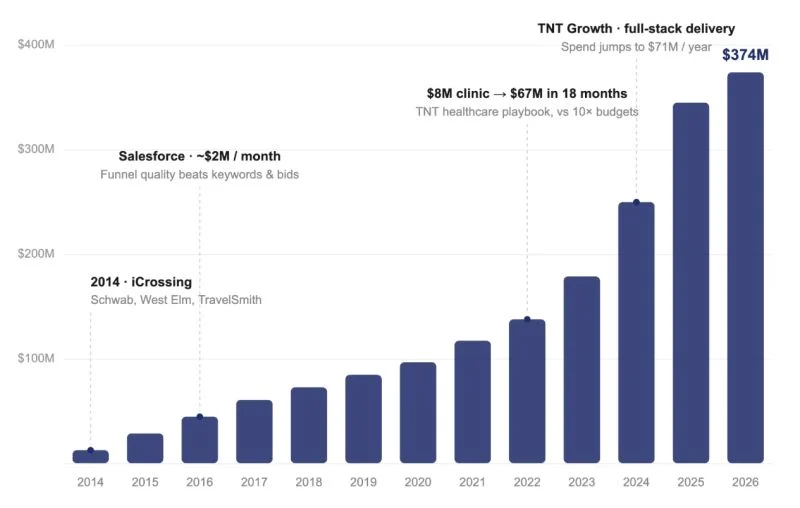
The figures below come from Adam’s original career retrospective. They cover agency, in-house, consulting, and TNT Growth work, so they should not be read as TNT-only company totals. The year-by-year estimate adds to roughly $374 million in Google spend. At the retrospective’s blended 3.75 return on ad spend, that represents about $1.5 billion in attributed revenue.
Google Ads career timeline at a glance
The timeline shows a progression from paid-search execution into growth systems, experimentation, measurement, and agency leadership.
| Period | Estimated spend | Role and environment | Main lesson |
|---|---|---|---|
| 2014 | $13M | iCrossing, enterprise paid search | Learn precision and account discipline |
| 2015 to 2017 | $48M | Salesforce, large-scale in-house search | Funnel quality beats isolated bid changes |
| 2018 to 2020 | $36M | Gusto plus consulting | Pages, experiments, and lifecycle shape paid results |
| 2021 to 2022 | $41M | Zinnia, consulting, healthcare | Offline business data changes bidding decisions |
| 2023 | $41M | TNT Growth and Zinnia | Move from individual execution to an operating model |
| 2024 | $71M | TNT full-stack delivery | Connect media, tracking, creative, pages, and revenue data |
| 2025 | $95M | Multi-vertical portfolio | Build repeatable standards across different economics |
| Jan to Apr 2026 | $29M | About $8M/mo total ads, $6M/mo Google | Use systems and AI to compound operator judgment |
2014: learn account discipline before chasing scale
The first year of Adam’s Google Ads career was at iCrossing, working on enterprise search for Charles Schwab, West Elm, and TravelSmith. The estimated spend was about $13 million.
Large, brand-sensitive accounts force an operator to respect process. A small wording error, tracking problem, or budget mistake can affect a recognizable company and a large audience. The lesson is not that everyone needs an enterprise logo on a resume. It is that disciplined habits should start before the budget becomes large.
Those habits include:
- Knowing exactly which change is being made and why
- Checking tracking before judging performance
- Separating brand, non-brand, product, and audience economics
- Recording material changes
- Understanding who approves risk
- Reviewing results after enough time has passed
A new specialist often wants to prove value through frequent action. A better early skill is knowing when the evidence supports a change and when the account needs more time.
2015 to 2017: funnel quality beats keywords and bids
At Salesforce, Adam moved in-house and managed paid search at a much larger scale. The period represented an estimated $48 million in spend, including roughly $2 million per month in 2016.
The main lesson was that search performance depends more on funnel quality than most platform discussions admit. Keywords and bids determine eligibility and cost. The funnel determines whether the click becomes a useful business outcome.
A paid-search operator should understand:
- What the searcher expects after the click
- Which conversion event the platform sees
- Which lead stages sales considers qualified
- How long those stages take to appear
- What a customer is worth
Google’s qualified lead and converted lead goals formalize the same idea. Advertisers can map offline CRM progress back to Google-generated leads instead of treating every form fill as equal.
If the platform optimizes toward shallow volume, better bidding can make the wrong outcome arrive faster. This is why our enterprise PPC playbook starts with qualification and measurement rather than a list of campaign settings.
2018 to 2020: move beyond the ad account
At Gusto, Adam’s work expanded from paid acquisition into analytics, experimentation, landing pages, and lifecycle. The period represented an estimated $36 million in spend, with consulting added in 2020.
This stage changed the job from “manage Google Ads” to “improve the acquisition system.” A landing page can change conversion rate, lead mix, and the message the market responds to. Lifecycle work can reveal whether the acquired user activates, buys, returns, or churns. Analytics can show whether the apparent winner survives outside the platform report.
The practical career lesson is to learn controlled experimentation. Google’s custom experiments allow advertisers to compare campaign changes against an original before applying them permanently. The same discipline applies to landing pages: define a hypothesis, split traffic fairly, choose one primary metric, and wait for a usable result.
Our landing-page testing guide covers the full operating loop. The important point for a Google Ads specialist is that conversion rate is not a fixed property of traffic. The offer, message, page, device experience, and qualification path all shape it.
2021 to 2022: connect Google Ads to business data
From 2021 through 2022, Adam ran work across Zinnia and consulting engagements including Routable, Giggster, Uniform Teeth, and Motive. Healthcare and treatment-center advertising became a major proving ground. The estimated spend for the period was about $41 million.
One case from the retrospective involved helping a specialty clinic grow from $8 million to $67 million in 18 months while competing with healthcare companies that had much larger budgets. The transferable lesson is not the headline. It is that a smaller advertiser can compete when the account has better feedback about which calls, appointments, admissions, or customers create value.
This period built conviction around lifetime value modeling and offline conversion data. A lead is not the endpoint. The operator needs to know whether it qualified, progressed, closed, and produced enough value to support the acquisition cost.
That feedback can be slow. Google’s conversion lag reporting explains that recent CPA may look inflated and ROAS may look low while conversions are still arriving. A specialist who reacts before the normal delay matures can cut a campaign that is working or scale one that only looks efficient.
2023: shift from operator to operating system
In 2023, the retrospective estimates about $21 million managed through TNT Growth and another $20 million at Zinnia. The challenge was no longer only making good account decisions. It was creating a system that could produce good decisions across multiple clients and operators.
This shift requires documentation, review standards, clear ownership, and escalation rules. A useful operating model defines:
| System | What it protects |
|---|---|
| Measurement QA | Prevents teams from optimizing to broken data |
| Account review cadence | Finds material risks before monthly reporting |
| Change records | Connects decisions to later outcomes |
| Conversion-delay rules | Reduces premature reactions |
| Client communication | Keeps assumptions and risks visible |
| Approval boundaries | Prevents automation or junior execution from creating hidden spend risk |
The senior skill is not doing every task personally. It is making the reasoning inspectable so another qualified operator can execute it without losing the standard.
2024 and 2025: full-stack delivery changes the job
The retrospective estimates about $71 million in 2024 and $95 million in 2025. TNT’s delivery expanded across Google Ads, creative, analytics, engineering, landing pages, and backend revenue data, with work spanning healthcare, SaaS, ecommerce, insurance, and other categories.
At this scale, a platform-only specialist reaches a ceiling. The same campaign structure can perform differently when the sales cycle, margin, buyer, intake process, or customer mix changes. The operator has to understand the category’s economics and know which adjacent team owns each constraint.
A senior Google Ads career therefore needs two types of depth:
- Platform depth: auctions, match types, bidding, budgets, creative, inventory, experiments, and policy
- Business depth: qualification, CRM stages, revenue, margin, capacity, conversion delay, and customer value
The best account recommendation connects both. “Increase target CPA” is incomplete. A useful recommendation explains which auctions should open, what qualified volume is expected, how much risk the change adds, and when the team will know whether it worked.
2026: use AI to compound judgment, not remove it
From January through April 2026, the retrospective estimates roughly $29 million in managed spend, with the broader portfolio running about $8 million per month in ads and about $6 million per month on Google.
The new challenge is turning years of operator judgment into repeatable systems without giving up accountability. AI can summarize pacing, classify search terms, prepare reports, and surface anomalies. It cannot decide what the business should optimize for or accept responsibility when a recommendation moves spend in the wrong direction.
Our human-supervised Google Ads AI agent workflow uses that boundary: AI handles inspection and preparation, while operators approve material changes.
For someone building a Google Ads career now, the durable position is not competing with automation on repetitive clicking. It is becoming the person who defines the goal, checks the data, designs the test, judges the risk, and explains the decision.
How to build a Google Ads career now
Use this progression:
- Learn account structure, search intent, bidding, budgets, ads, and policy.
- Master conversion tracking and verify data outside the platform.
- Learn spreadsheet analysis and basic forecasting.
- Study landing pages, offers, and buyer behavior.
- Understand conversion lag and sales-cycle timing.
- Run controlled tests and keep a learning record.
- Practice explaining recommendations in business terms.
- Take responsibility for a small budget before seeking a larger one.
- Learn how CRM stages and customer value feed bidding.
- Use AI for repetitive inspection, then review every material conclusion.
The fastest way to stall is to memorize tactics without understanding the system. Platforms change. The ability to connect demand, measurement, customer economics, and experimentation remains useful.
The takeaway
A Google Ads career is a strong path for an operator who wants measurable responsibility and is willing to learn beyond the ad account. Adam’s 12-year retrospective moved from enterprise search execution to funnel quality, experimentation, offline data, full-stack delivery, and multi-operator systems.
The spend increased, but the more important progression was the scope of the decision. Early decisions changed keywords and bids. Later decisions changed what the platform learned from the business and how a team managed risk across millions in monthly spend.
TNT Growth applies that operating model for brands spending $75K+/mo. Review our paid media and measurement services, see results tied to qualified revenue, or book a call to identify the constraint in your Google Ads system.
Frequently asked questions
Is Google Ads a good career?
Google Ads can be a strong career for people who like quantitative analysis, customer behavior, experimentation, and commercial accountability. The durable path goes beyond platform buttons. Learn conversion tracking, landing pages, sales funnels, finance, and how to explain decisions. Those skills remain useful as bidding and campaign execution become more automated.
What skills do you need for a Google Ads career?
Start with account structure, search intent, bidding, budgets, ads, and measurement. Then add spreadsheet analysis, CRM data, landing-page testing, conversion lag, customer economics, and clear communication. Senior operators are valuable because they connect platform performance to qualified pipeline and revenue, not because they know every menu location.
How do you get experience managing large Google Ads budgets?
Earn larger responsibility by showing disciplined decisions on smaller accounts. Keep change records, reconcile platform data with business outcomes, explain risk before changing spend, and document what happened after normal conversion delay. Agency and in-house roles can both provide scale, but the quality of measurement and mentorship matters more than the logo.
Should a Google Ads specialist learn landing-page testing?
Yes. Search performance depends on what happens after the click. A specialist who can diagnose message match, offer clarity, proof, friction, and form quality can solve problems that bidding changes cannot. Landing-page testing also teaches controlled experimentation, which improves how the operator evaluates campaign changes.
Will AI replace Google Ads specialists?
AI will automate more reporting, classification, and campaign execution, but the operator still has to define the business outcome, provide clean data, judge risk, design tests, and take responsibility for spend. The safer career position is to use AI for inspection and preparation while becoming stronger at measurement, strategy, and commercial judgment.