
An AI marketing workflow works when context lives outside the chat, each agent has a narrow job, every output is logged, and risky changes wait for human approval. Adam uses this operating model across more than $70 million in annual ad spend. The model matters less than the durable files, rules, review steps, and accountability around it.
What is an AI marketing workflow?
An AI marketing workflow is a repeatable operating process, not a one-off prompt. It gives an AI system a defined source of truth, a narrow task, an expected output, and a clear handoff. The workflow also states what the system cannot do, who reviews the result, and how the team can inspect what happened later.
The distinction matters because marketing work carries real risk. A bad summary wastes time. A bad campaign write can waste budget. A wrong CRM update can corrupt reporting. A weak customer email can damage trust. The more direct the workflow’s effect on spend, customers, or published claims, the stronger the controls should be.
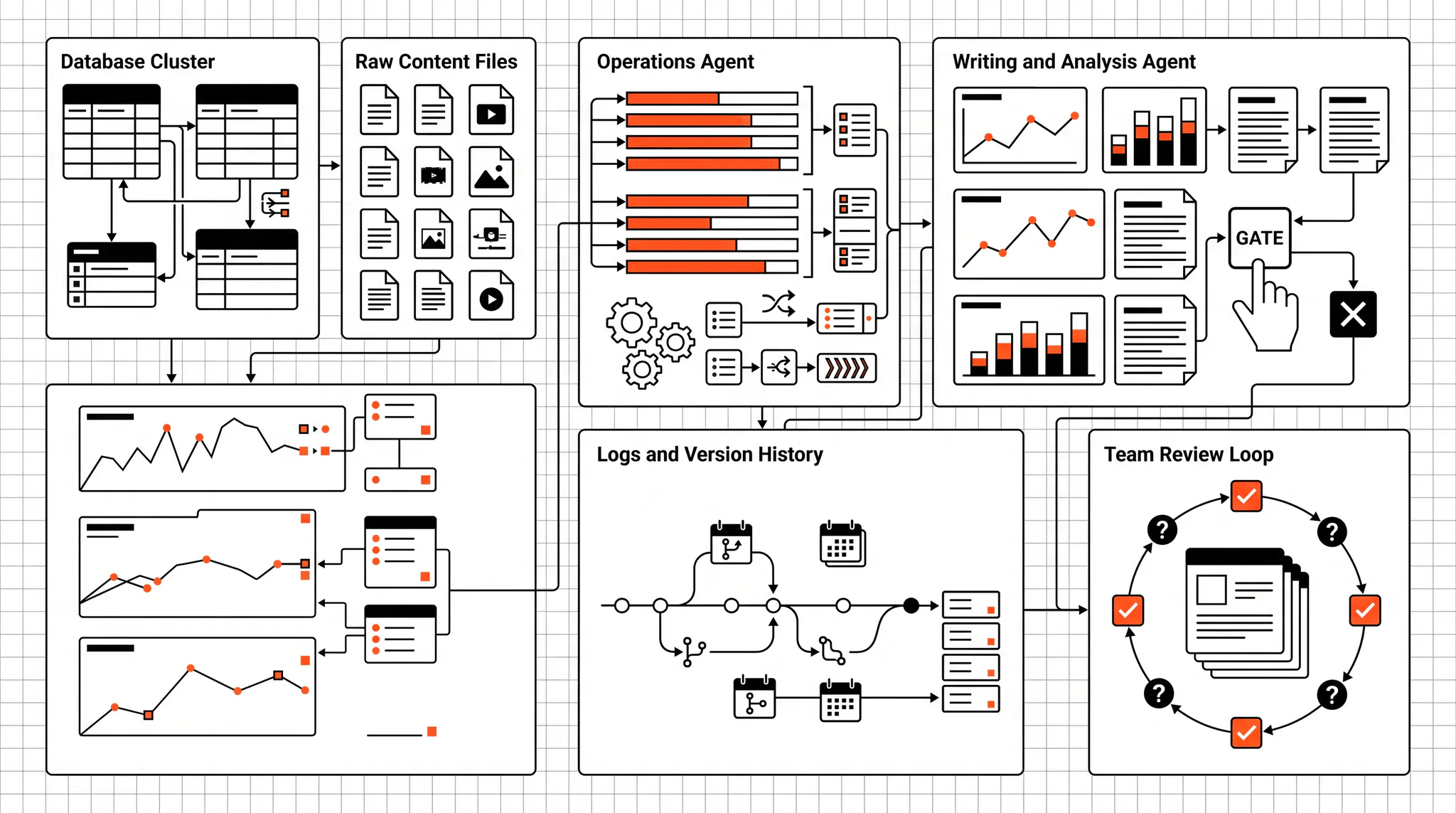
Adam’s system has six connected layers:
| Layer | Job | Failure without it |
|---|---|---|
| Durable source | Stores rules, records, targets, and business context | Every run starts from partial memory |
| Operations agent | Handles exact, machine-state work | Creative tools are forced into brittle execution tasks |
| Writing and analysis agent | Drafts and interprets context-heavy work | Operational scripts are asked to make subjective judgments |
| Logs and version history | Records inputs, outputs, and changes | Errors cannot be traced or reversed cleanly |
| Approval gate | Holds risky writes for a person | One weak output can change a live system |
| Team review loop | Adds new knowledge through a shared process | Context stays trapped with one operator |
1. Make the work agent-readable
The first step is not choosing a model. It is making the work understandable to a system that has no access to the unwritten context in your head.
An agent-readable process names the inputs, definitions, constraints, and expected output. Instead of “review campaign performance,” the workflow specifies the accounts, date range, spend target, qualified conversion definition, conversion delay, recent changes, and the conditions that deserve attention.
A useful task contract includes:
- The exact source files, tables, or APIs to read
- The business definition of each metric
- The date range and refresh time
- The decision the output should support
- The required output format
- Conditions that mean “stop and ask”
- Actions the workflow is never allowed to take
- The person responsible for the final decision
This is why narrow workflows outperform broad instructions. “Draft the weekly client report from these verified fields” can be tested. “Run marketing” cannot.
What goes wrong when context stays implicit
A chat can produce a convincing answer while missing the target, using stale definitions, or treating a delayed conversion as a performance problem. The output sounds complete because the missing context is invisible.
Write the operating rules down. If the team cannot explain how a task should work without referring to one person’s memory, the task is not ready for reliable automation.
2. Put durable state in files and databases
Durable state means the workflow can read the same source of truth tomorrow, another operator can inspect it, and the team can see what changed. In Adam’s setup, important context lives in files, databases, logs, and version history instead of disappearing inside isolated chat threads. His Obsidian second brain and GitHub workflow shows how that file-based layer separates raw captures, reviewed sources, meetings, and approved company knowledge.
The source layer can include:
- Brand and copy rules
- Campaign targets and conversion definitions
- Client context and account constraints
- Approved procedures and checklists
- Forecast assumptions
- CRM stage definitions
- Open issues and pending reviews
- Logs of prior decisions and outcomes
Files are useful for instructions, checklists, and written context. Databases are useful for structured records, metrics, status, and relationships. Logs show what the workflow did. Version history shows how the system changed.
The benefit is not technical neatness. It is reviewability. When an output looks wrong, the operator can ask which rule, record, or source produced it. When a process changes, the team can compare the old and new version instead of guessing what someone edited in a prompt.
Our marketing forecasting model uses the same principle: assumptions need an owner, a source, and a refresh cadence. An AI workflow cannot improve a forecast whose definitions move every week without documentation.
3. Assign different agents to different kinds of work
One model can do many jobs, but that does not mean every job should use the same workflow. Adam separates exact operational work from voice-sensitive writing and analysis.
The operations layer handles tasks where the answer depends on machine state, structured records, and repeatable execution. Examples include checking automations, reading logs, validating CRM workflows, preparing scorecards, or identifying broken processes.
The writing and analysis layer handles tasks where context, tone, synthesis, and judgment matter more. Examples include drafting reports, turning rough thinking into clear prose, analyzing patterns, and preparing a decision brief.
| Work type | Better starting role | Why |
|---|---|---|
| Data inspection | Operations agent | Exact fields and state matter most |
| Automation diagnostics | Operations agent | Logs and failure modes need structured checks |
| CRM change proposal | Operations agent plus approval | Field-level diffs must be precise |
| Client report draft | Writing and analysis agent | Tone and business context matter |
| Content draft | Writing and analysis agent | Voice, structure, and evidence matter |
| Campaign recommendation | Analysis plus operator review | Data and commercial judgment must meet |
The split reduces failure radius. A writing agent should not receive broad permission to change a CRM because it wrote a useful summary. An operations agent should not publish external copy because it completed a clean data check.
4. Log outputs and keep version history
A marketing workflow becomes trustworthy when the team can reconstruct what happened. That requires more than saving the final document.
A useful log records:
- When the workflow ran
- Which sources and time periods it read
- Which rules or workflow version applied
- What it observed
- What it proposed
- What the reviewer approved, changed, or rejected
- What happened after the approved action
Version history matters for the workflow itself. If a classification rule changes, record the change and why. If a report template starts using a new revenue definition, show the diff. If a model update changes output quality, test it against known examples before making it the default.
The NIST AI Risk Management Framework says documentation can improve transparency, human review, and accountability. It also calls for clearly documented roles, human oversight processes, ongoing monitoring, and change management. That guidance applies directly to marketing operations where AI output can affect budgets, customer data, and public claims.
Logs are not a substitute for ownership
A detailed record does not make a weak decision safe. A named person still needs to own the business outcome. Logs let that person review evidence, investigate errors, and improve the system. They do not transfer accountability to the software.
5. Put risky writes behind an approval gate
The safest first version of an AI marketing workflow is read-only. It gathers evidence, identifies a problem, prepares a draft, or proposes a field-level change. A person decides what happens next.
Adam’s operating rule is strict: risky changes run as a dry proposal before anything is written. The reviewer sees what will change, which records are affected, and why the workflow recommends it.
Approval should be required for changes to:
- Ad bids, budgets, targeting, keywords, assets, or conversion goals
- CRM fields, lifecycle stages, ownership, or workflow enrollment
- Customer and prospect communications
- Public website or campaign claims
- Financial models and reporting definitions
- Data deletion, merging, or irreversible updates
A practical approval record includes the proposed diff, evidence, reviewer, decision, timestamp, and recovery path. For recurring low-risk tasks, the team may later narrow the approval rule. That decision should follow measured accuracy, known edge cases, and a clear rollback process.
This is the broader operating system behind our human-supervised Google Ads AI agent. The agent can inspect pacing, triage search terms, and draft reports. It does not receive unrestricted permission to change live campaigns.
6. Let the team write into the system
A private knowledge base helps one operator. A shared review loop helps the company. Our guide to building team-owned AI marketing skills shows how to assign one operator to each workflow gap, test the skill against real cases, and publish it with an owner.
Adam’s next step is a team workflow where people add proposed knowledge through a reviewed change. A growth manager can contribute a new account pattern, checklist update, or edge case. A team lead reviews it. Once approved, the update becomes part of the shared operating layer that future workflows can read.
This creates a compounding loop:
- The team does the work.
- A new pattern or edge case appears.
- Someone proposes an update to the shared source.
- A reviewer checks the evidence and wording.
- The approved change enters the operating system.
- Future people and agents use the improved context.
Without review, the knowledge base fills with contradictions. Without contribution, it becomes stale. The loop needs both openness and ownership.
Worked example: AI-assisted search-term review
Search-term review shows how the full system fits together.
The durable source contains the product description, ideal customer profile, valid edge cases, conversion definitions, and negative-keyword rules. The operations workflow pulls the latest search terms and joins them with spend and qualified conversion data. The analysis layer scores relevance and explains uncertain cases. The system produces a proposed review queue, not a live exclusion list.
A growth manager approves, edits, or rejects each proposed negative. The final decision, match type, and scope are logged. The team then monitors spend and qualified outcomes after the approved changes.
Our AI-assisted Google Ads negative keyword workflow used this structure to reduce 4,500 raw search terms to a focused human review. The same pattern can turn a crowded inbox into an AI second brain for newsletters without treating every summary as trusted knowledge. The useful part is not that AI reads the rows or messages. It is that context, evidence, review, and post-change monitoring are built into the process.
How to build an AI marketing workflow yourself
Start with one recurring task that consumes time but has a clear source and output.
- Write the task as a repeatable decision, not a broad goal.
- Name the authoritative files, tables, fields, and date range.
- Define every metric and business term the workflow uses.
- Separate observed facts from interpretation.
- State the output format and the person who owns it.
- Add stop conditions for missing, stale, or conflicting data.
- Keep the first version read-only.
- Require evidence and a proposed diff for any change.
- Log the run, review, and final decision.
- Measure accuracy, rework, false positives, time saved, and business impact.
- Update the workflow only through a reviewed change.
Do not start with the highest-risk process. Begin with inspection, classification, or drafting. Prove that the workflow can read the right context and produce a useful result before expanding permissions.
When not to automate the workflow
Keep the work manual when the source data is unreliable, the team cannot agree on the business definition, the task changes every time, the decision depends on sensitive context that is not documented, or one mistake would create a large customer or financial impact.
Also keep it manual when nobody owns the output. Automation without accountability makes a weak process harder to inspect because the work happens faster and more often.
The right question is not “Can AI do this?” Ask whether the task has a stable source, a testable output, a named reviewer, and a safe recovery path.
The takeaway
A reliable AI marketing workflow is an operating system around the model. Put context in durable files and databases. Assign narrow jobs. Keep logs and version history. Route risky changes through a named reviewer. Let the team improve the shared source through controlled updates.
The model will change. The operating discipline should remain. That is how Adam uses AI across more than $70 million in annual ad spend without giving a tool unchecked authority over campaigns, data, or customer communication.
TNT Growth runs senior-led paid media, conversion tracking, and marketing operations for brands spending $75K+/mo. Review our growth and tracking services, see results tied to revenue, or book a 30-minute ad audit to find the highest-value workflow to improve first.
Frequently asked questions
What is an AI marketing workflow?
An AI marketing workflow is a repeatable process where an AI system reads defined business context, completes a narrow marketing task, records its output, and routes the result to a person or another system. A reliable workflow names the source of truth, owner, approval rule, and failure mode instead of relying on one long chat prompt.
How do you use AI in marketing operations?
Start with repetitive inspection, drafting, classification, and reporting tasks. Put the relevant data, rules, targets, and prior decisions in durable files or databases. Assign a narrow job to the AI, require cited evidence, log the output, and keep a human approval gate in front of changes that affect spend, customers, or external communications.
Why should AI workflow state live in files?
Files and databases make context durable, reviewable, and versioned. The team can see which rules applied, what source data the agent read, what changed, and who approved the result. Chat-only workflows lose context, hide assumptions, and make it harder to reproduce or audit a decision later.
Should AI agents make marketing changes automatically?
Not by default. Read-only analysis and first drafts are safer starting points. Any workflow that changes bids, budgets, campaign settings, CRM records, customer messages, or published content should have explicit permissions, a proposed diff, a named approver, logs, and a recovery path before automated writes are considered.
How do you measure whether an AI marketing workflow works?
Measure decision quality, review time, error rate, false positives, rework, and business impact. Speed alone is not enough. A useful workflow reduces repetitive work while preserving or improving accuracy, operator judgment, accountability, and the quality of the final marketing decision.