
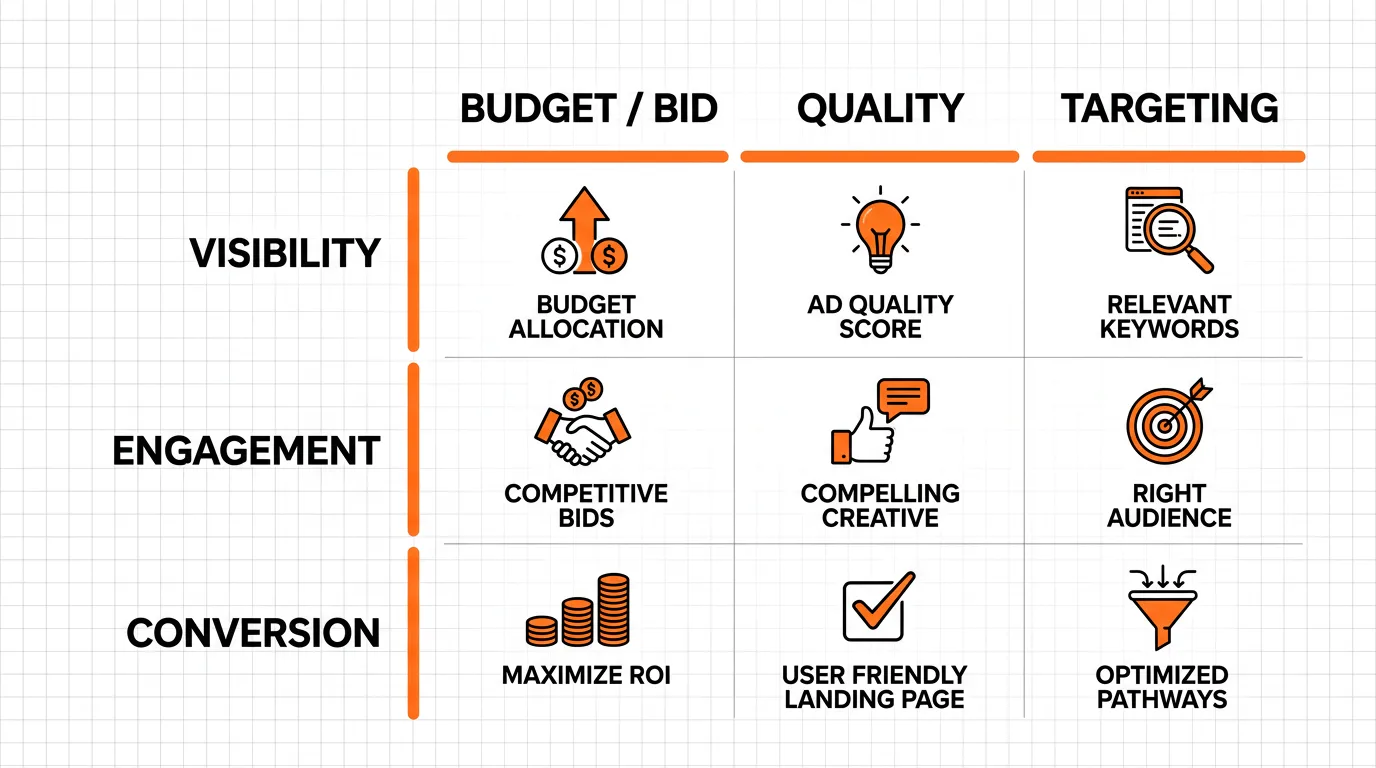
Google Ads optimization works best when you diagnose the constraint before changing the account. Start by asking whether the campaign has a visibility, engagement, or conversion problem. Then test the three controls that can cause it: budget or bidding, quality, and targeting. This 3×3 matrix turns scattered metrics into one ordered decision process.
Why Google Ads optimization needs a diagnostic model
Most account changes start with a symptom. Spend falls, so someone raises budget. Click-through rate drops, so someone rewrites ads. Cost per lead rises, so someone tightens match types. Each response works only when it addresses the actual constraint.
The matrix separates three performance problems from three control groups:
| Performance problem | What it means | Controls to inspect |
|---|---|---|
| Visibility | The ads are not entering or winning enough eligible auctions | Budget and bids, quality, targeting |
| Engagement | The ads show, but the right people do not click | Bids and position, creative quality, audience or query fit |
| Conversion | Clicks arrive, but too few become qualified outcomes | Bid strategy, landing-page quality, traffic and conversion targeting |
Google defines Search impression share as impressions received divided by estimated eligible impressions. Search Lost IS from budget and rank help split a delivery problem into two very different causes. That is the value of the matrix: it tells you which branch to investigate before you make a change.
Google Ads optimization box 1: low visibility from budget or bids
Low visibility from budget or bidding means the campaign qualifies for useful traffic but cannot enter enough auctions. The clearest signs are meaningful Search Lost IS from budget, a campaign that exhausts its daily budget early, or a target CPA or target ROAS that restricts serving.
First, confirm the campaign is profitable on qualified conversions. Then check whether the budget or target is the limiting factor. A campaign can have budget available and still serve poorly if the Target CPA is far below recent performance. Google’s troubleshooting guidance notes that low bid targets can prevent campaigns from entering or winning enough auctions.
Raise budget when the campaign is profitable and budget-limited. Loosen the target in small steps when the bid goal is unrealistic. Do not change both at once. If the account is already spending freely but pipeline is weak, this is not the right box.
Box 2: low visibility from weak quality
Low visibility from quality means the account is eligible for the search, but its Ad Rank is not competitive enough to win the impression. Look for high Search Lost IS from rank, below-average ad relevance or landing-page experience, and weak click-through rate across a stable set of queries.
Quality is not one score to chase. It is the connection between the search, ad, offer, and landing page. Google’s ad and landing-page optimization guide recommends tightly themed ad groups, relevant copy, regular search-term reviews, and landing pages that continue the promise made in the ad.
Improve the weakest link. Rewrite ads when the message does not match the query. Fix the page when users click but cannot quickly find the promised offer. Review the offer when competitors provide a clearer reason to choose them. Our analysis of 3,900 ads found that Ad Strength did not correlate with CPA, so do not confuse Google’s asset-completeness grade with business performance.
Box 3: low visibility from narrow targeting
Low visibility from targeting happens when budgets and quality are healthy but the campaign has too little eligible demand. Keywords may be too narrow, geography may exclude viable markets, or negative keywords may block relevant searches.
Check the keyword universe, search-term coverage, geographic settings, audience restrictions, and negative lists. If exact match is efficient but capped, add phrase or broad match only after conversion tracking and Smart Bidding are ready. Our broad match versus exact match data shows why broader matching can add large volume without giving up CPA when the guardrails are strong.
Do not broaden a campaign that is already attracting weak leads. Wider targeting multiplies the value of a clean conversion signal, but it also multiplies a bad one.
Box 4: low engagement from bids or position
Low engagement from bids means ads appear, but they often show in positions where the click opportunity is weaker. Compare click-through rate with top impression rate, absolute top impression rate, and Auction Insights. A strong ad can still struggle when competitors consistently appear above it for the most valuable queries.
Test bid changes only on terms with proven downstream value. A higher position is not automatically better if the extra clicks do not become qualified pipeline. Use an experiment or a controlled target adjustment, then judge the result on qualified conversion cost rather than click-through rate alone.
If click-through rate is weak at strong positions, stop bidding harder. Move to the quality or targeting branch.
Box 5: low engagement from weak creative
Low engagement from quality means the ad appears for the right search but gives the user no strong reason to click. Generic headlines, vague benefits, missing proof, and poor message match are common causes.
Google recommends matching responsive search ads to the landing page and evaluating performance beyond one ad-level metric. That matters because an ad’s job is not to collect every click. It is to attract the right prospect and set the right expectation.
Write around the query’s job, the buyer’s qualification criteria, and the next step. For a high-ticket offer, pricing minimums or buyer requirements may lower click-through rate while improving economics. Our guide to disqualification ads explains how copy can filter weak prospects before they consume budget.
Box 6: low engagement from wrong targeting
Low engagement from targeting means the ad is serving to people who do not recognize the offer as relevant. The account may use broad themes without enough negatives, mix consumer and business intent, or apply audience settings that do not match the buyer.
Pull the search terms report and group queries by product fit, buyer fit, and stage of intent. Add negatives for clear mismatches. Separate materially different intents when they need different ads or landing pages. Keep ambiguous terms long enough to collect evidence instead of cutting them after one click.
The failure mode is optimizing copy for the wrong audience. A better headline cannot rescue traffic that should never have entered the campaign.
Box 7: low conversion from budget or bid strategy
Low conversion from budget or bidding appears when clicks are relevant but the bidding system favors cheap conversions over valuable ones, or when an aggressive target reduces the campaign’s ability to find enough qualified demand.
Audit the selected conversion goals, the bid strategy, the target, and conversion delay. Maximize Conversions can chase volume without a firm cost guardrail. Target CPA can add control, but a target set far below history can restrict traffic. Budget constraints can also distort Smart Bidding by forcing the campaign to choose among auctions all day.
Use the Google Ads conversion action framework to confirm the campaign is optimizing toward the deepest reliable event with enough volume. Fix the signal before fine-tuning the target.
Box 8: low conversion from the landing page
Low conversion from quality means the search and ad did their jobs, but the page did not. Check message continuity, page speed, mobile usability, form friction, proof, offer clarity, and whether the conversion event fires once and only once.
A useful page answers four questions quickly: Am I in the right place? Is this for someone like me? Why should I trust it? What happens next? Google’s landing-page guidance says the destination should closely match the ad and make the desired action easy to complete.
Do not redesign from preference. Segment conversion rate by device, campaign, query theme, and landing page. Fix the largest verified break first, then run a controlled test.
Box 9: low conversion from wrong traffic or signal
Low conversion from targeting is often the most expensive box because Google can report healthy activity while the CRM shows weak pipeline. The campaign may target the wrong queries, optimize for a shallow event, count duplicates, or treat spam and qualified opportunities as equal.
Compare Google Ads conversions with CRM stages and revenue. Review search terms alongside lead quality, not just form fills. Confirm primary and secondary conversion actions, counting settings, offline imports, and retractions. If the account optimizes for form submissions while sales cares about qualified opportunities, the algorithm is solving the wrong problem.
This is where server-side conversion tracking and CRM feedback matter. Clean downstream events let broader targeting work. Noisy events make every optimization less reliable.
How to run the Google Ads optimization matrix yourself
Use the same order every time so short-term noise does not push you into random changes:
- Define the business outcome and confirm the conversion event represents it.
- Pull impression share, Lost IS from budget, Lost IS from rank, click-through rate, conversion rate, and qualified CPA.
- Check the Google Ads metrics reporting guide for conversion lag, new-customer mix, view-through results, auction overlap, and hidden search-term spend.
- Choose the main problem row: visibility, engagement, or conversion.
- Test each control column with supporting evidence.
- Write one diagnosis in plain language, such as “qualified traffic is capped by narrow targeting.”
- Make the smallest change that tests the diagnosis.
- Wait for enough conversion data and conversion delay before judging it.
- Record the result, then move to the next constraint.
The matrix identifies the one box that best explains the current problem. When the issue crosses channels or extends beyond the ad account, use the broader MECE marketing funnel analysis framework to trace the first break from auction metrics through revenue.
Common Google Ads optimization mistakes
The biggest mistake is changing budget, bids, ads, targeting, and conversion goals together. The account may improve, but you will not know why. It may also get worse while each individual change hides the cause.
Other mistakes include optimizing to platform conversions instead of qualified pipeline, chasing Quality Score without checking CPA, broadening targeting before the signal is clean, judging long sales cycles on a seven-day window, and treating Google’s recommendations as instructions instead of hypotheses. A quick Google Ads campaign settings audit catches auto-applied changes, expanded networks, and weak conversion signals before they distort the diagnosis.
When tracking is broken or a major site issue changed conversion behavior, pause optimization. Repair measurement first. You cannot diagnose an account from data you do not trust.
The takeaway
Google Ads optimization is a diagnosis problem before it is a settings problem. Classify the issue as visibility, engagement, or conversion. Then test budget or bidding, quality, and targeting as the possible causes. The 3×3 matrix keeps operators focused on the constraint that matters instead of making five unrelated changes and hoping one works. Once the diagnosis is clear, use the six-system Google Ads management checklist to put search terms, landing pages, tracking, assets, and bidding on a recurring schedule.
TNT Growth runs senior-led Google Ads and down-funnel tracking for brands spending $75k+/mo. Review our Google Ads and tracking services, see results tied to revenue, or book a call for a diagnostic review of your account.
Frequently asked questions
What is Google Ads optimization?
Google Ads optimization is the process of diagnosing and improving campaign performance across delivery, engagement, and conversion. A useful process identifies whether the constraint is budget or bidding, quality, or targeting before changing settings. The goal is to fix the cause of weak performance instead of reacting to one metric in isolation.
Which Google Ads metrics should I check first?
Start with impression share, Search Lost IS from budget, Search Lost IS from rank, click-through rate, conversion rate, and cost per qualified conversion. Those metrics show whether the account has a visibility, engagement, or conversion problem. Then inspect search terms, conversion actions, landing pages, and recent change history for the cause.
How often should Google Ads campaigns be optimized?
Review high-spend campaigns weekly for pacing, search terms, conversion health, and major delivery changes. Run a deeper diagnostic monthly or whenever performance moves outside the expected range. Avoid making daily structural changes when conversions take days or weeks to appear, because short windows can make normal conversion lag look like a problem.
Should I raise budget when Google Ads performance drops?
Not automatically. Raise budget when profitable campaigns are losing meaningful impression share because of budget and the conversion signal is trustworthy. If visibility is weak because of rank, targeting, or an unrealistic bid target, more budget will not fix the cause. Diagnose the matrix box first, then change the matching control.