
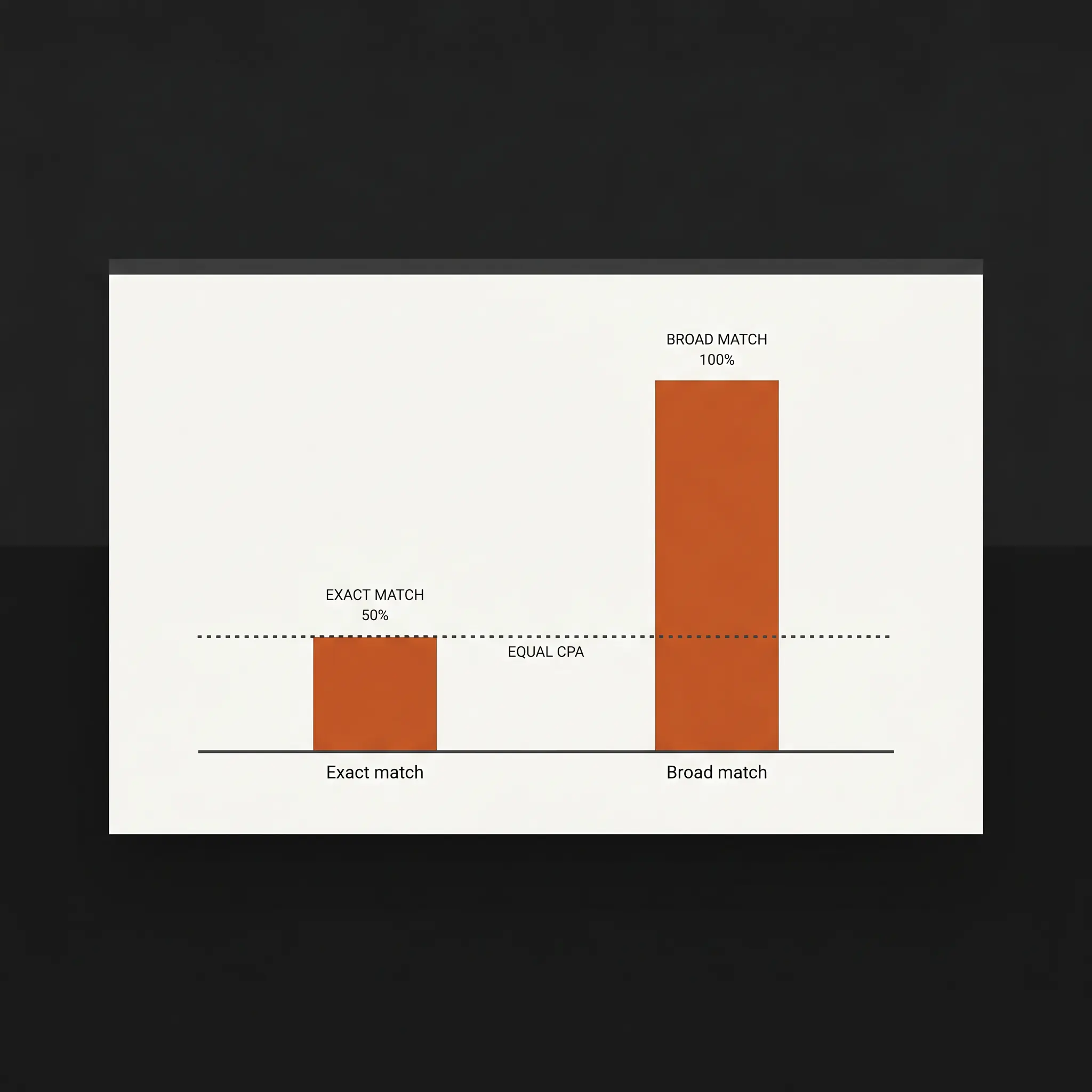
Can broad match beat exact match in Google Ads? Yes, if you run it right. Exact match wins on the lowest cost per conversion, but it caps out fast. On one account, broad match delivered about 31x the conversions of exact (6,100 versus 194) at within 1% of the same cost per conversion. The catch is that broad only works when it is paired with Smart Bidding, aggressive negatives, and clean conversion data.
When narrow wins, and where it stops
Exact match usually posts the lowest cost per conversion. It only bids on the obvious, highest-intent terms, so nearly every click is qualified. That is exactly where the old warning “broad match burns budget” comes from, and on an unmanaged account it is true.
But narrow caps out. Once you have captured the handful of high-intent queries, exact has nowhere left to grow. Broad match adds conversion volume while holding close to the same efficiency. The real question is not “which is cheaper per click,” it is “how much more volume can you buy at close to the same CPA.”
The data: 31x the volume at the same CPA
Here is one account where broad match, run properly, blew past exact on volume without giving up efficiency.
| Match type | Spend | Conversions | Cost per conversion |
|---|---|---|---|
| Exact | ~$3.3K | 194 | $16.93 |
| Broad | ~$104K | 6,100 | $17.10 |
Broad drove about 31x the conversions of exact, at a cost per conversion within roughly 1% of exact’s. If you had judged broad on cost per click alone, you would have killed the single biggest source of profitable volume in the account. Judged on cost per conversion, it is obviously the winner. This is the same lesson as our finding that Ad Strength does not predict CPA: the surface metric and the money metric often disagree.
How to run broad match properly
Broad match is not a setting you flip on. It is a system with four requirements. Miss any one and it does burn budget.
1. Turn it on in the right order
Do not open with broad. Layer exact first on each theme, move to phrase once that theme clears 15+ conversions a month, and add broad only after Smart Bidding is mature and tracking is clean. Broad learns from your conversion history, so if you turn it on before you have that history, you pay for the algorithm to learn on your dime. Google’s own keyword matching options documentation is the reference for how each type expands.
2. Run aggressive negatives
Negatives are the fastest CPA win in any account, and broad depends on them. Build an aggressive list from day one and pull the search term report weekly, keeping the terms that hit your target and negating the rest. On large accounts, use an AI-assisted negative keyword workflow to prioritize the review without giving the model write access. One clear tell: if your regular impression share sits at 40% but your exact-match impression share is 90%, the gap is broad-match junk. Cut it. This is the same discipline behind using ad copy as a filter to disqualify bad clicks.
3. Guard the bid
Go wide on match type, tight on bid strategy. Put broad under Target ROAS or Target CPA so a loose query only earns a bid when it can clear the target. Set the target at or above your trailing CPA. Set it below at the start and you can lose 40% of traffic overnight. Watch Search Lost IS (Budget): above zero means the target is too tight, so move it 5 to 10% at a time and wait a conversion cycle or two.
4. Feed clean signals
Broad hands term selection to Google, so your conversion data is the steering wheel. Fire conversion actions at every stage and weight the down-funnel ones heavier, then retract bad leads within 24 hours so Google stops building lookalikes of your junk. This matters more on broad than anywhere else, because broad is the match type most dependent on the algorithm’s read of who converts. Use the Google Ads lead-quality framework to pair match-type breadth with the deepest conversion signal the account can support. It is the same signal discipline that lets us scale accounts on deep, down-funnel conversions.
The takeaway
Broad match versus exact match is not a loyalty question. Exact wins on the tightest, cheapest terms and caps out. Broad, run with Smart Bidding, aggressive negatives, a target-backed bid, and clean conversion signal, can multiply your volume many times over at nearly the same CPA. If you are unsure whether targeting is actually the constraint, run the 3×3 Google Ads optimization matrix before broadening. Run broad without those four guardrails and the old warning holds: it will burn your budget.
If you want a team that runs broad match at scale without blowing up CPA, TNT Growth manages full-stack Google Ads for brands spending $75K+/mo. Book a call and we will show you where your match types are leaking.
Frequently asked questions
Can broad match beat exact match in Google Ads?
Yes, when it is run correctly. Exact match usually wins on the lowest cost per conversion because it only bids on the highest-intent terms, but it caps out on volume fast. On one account, broad match delivered about 31x the conversions of exact (6,100 vs 194) at within 1% of exact's cost per conversion, because it was paired with Smart Bidding, aggressive negatives, and clean conversion data.
When should you turn on broad match?
Not at launch. Layer exact match first on each theme, move to phrase once it clears about 15 conversions a month, and add broad only after Smart Bidding is mature and tracking is clean. Broad learns from your conversion history, so turning it on before you have that history means paying for the algorithm to learn.
How do you stop broad match from wasting budget?
Run an aggressive negative keyword list from day one and pull the search term report weekly. A useful tell: if your overall impression share is around 40% but exact-match impression share is 90%, the gap is broad-match junk, so cut it. Also cap risk by putting broad under Target CPA or Target ROAS so a loose query only gets a bid when it can hit your target.
Should broad match use Target CPA or Target ROAS?
Yes, always pair broad with a smart bidding strategy like Target CPA or Target ROAS. Set the target at or above your trailing CPA. Setting it too low at the start can cut 40% of traffic overnight. Watch Search Lost IS (Budget): if it climbs above zero, the target is too tight, so loosen it 5 to 10% at a time and wait a conversion cycle or two.