
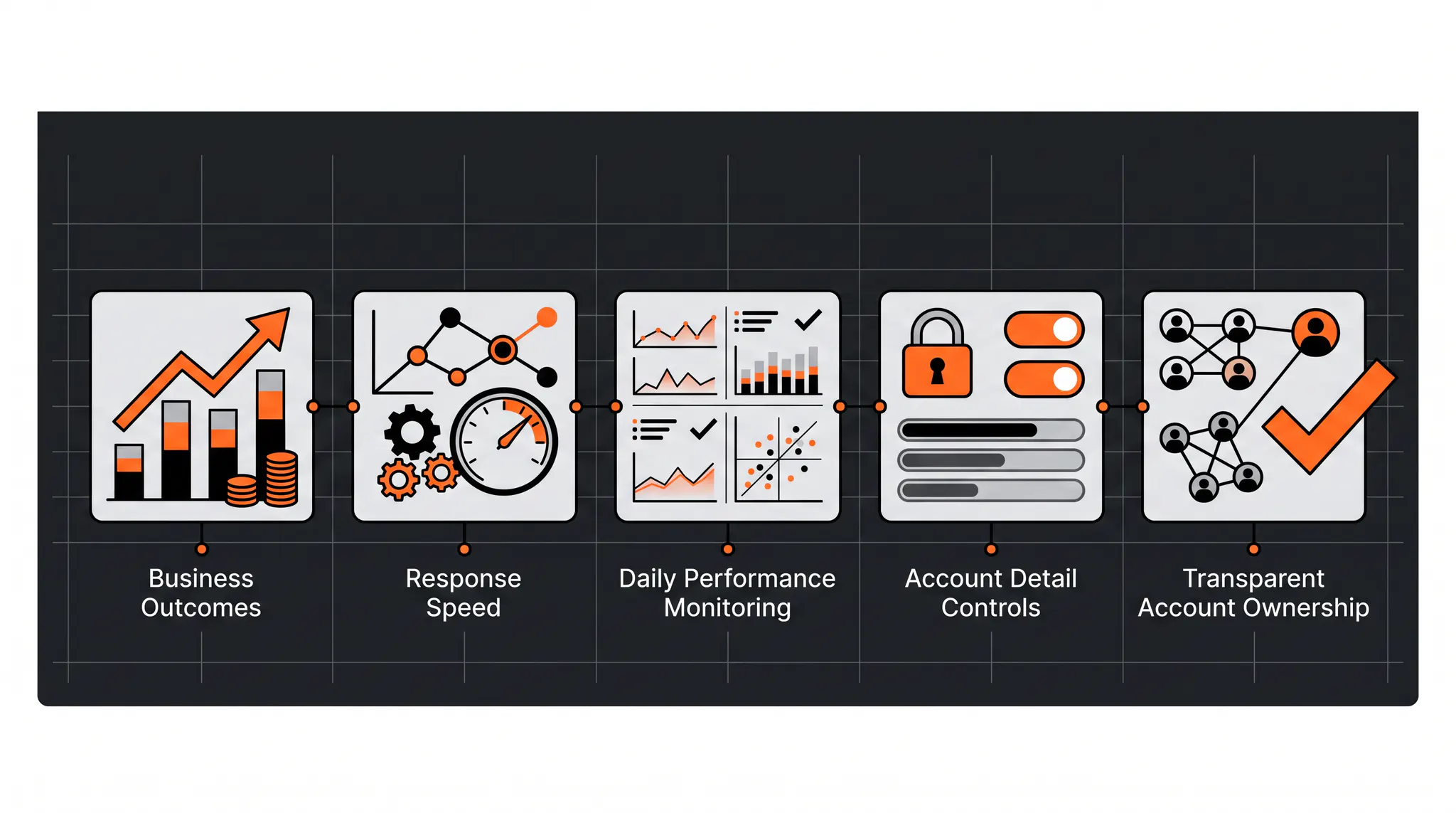
A Google Ads agency should do more than launch campaigns and send a monthly report. It should define the business outcome, connect advertising data to qualified pipeline, watch performance closely, explain every material decision, and leave the client in control of the account. Use these standards to separate real operators from polished presentations.
What does a Google Ads agency actually do?
A Google Ads agency manages the full path from search query to business result. That includes campaign structure, keywords, bidding, budgets, ads, landing pages, conversion tracking, and reporting. The strongest agencies also connect ad clicks to CRM stages so Google learns which leads become qualified opportunities, customers, and revenue.
Platform CPL can look healthy while sales receives poor-fit inquiries. An agency that stops at clicks, conversions, and platform CPA may optimize the account efficiently toward the wrong outcome.
A serious Google Ads management agency should be able to handle or coordinate five operating layers:
| Operating layer | Core responsibility | Evidence to request |
|---|---|---|
| Measurement | Define primary conversions and connect Google Ads with the CRM | Conversion map, reconciliation process, qualified-stage reporting |
| Demand capture | Structure brand, competitor, and non-brand campaigns around intent | Search-term reviews, negative-keyword process, campaign rationale |
| Economics | Manage bids and budgets against acquisition and revenue goals | Qualified CPA, pipeline, revenue, forecast, marginal-spend view |
| Conversion | Improve the page and offer behind the click | Testing backlog, hypotheses, conversion-rate reporting |
| Operations | Monitor, communicate, document, and protect account access | Response expectations, change log, named owners, access policy |
If an agency cannot explain how these layers connect, it is probably managing the interface rather than the acquisition system. Our Google Ads for SaaS operating guide shows what that connected system looks like in practice.
Google Ads agency standard 1: sell outcomes, not activity
A good agency defines success using qualified pipeline, customers, revenue, or another verified business result. Campaign launches, reports, meetings, and optimization checklists are work products. They matter, but they are not the result the client hired the agency to create.
Start the selection process by asking one question: What metric will determine whether this engagement is working?
Weak answers stay inside Google Ads:
- Click-through rate
- Form fills
- Platform CPA
- Impression share
- Ad Strength
Stronger answers connect those signals to the business:
- Cost per qualified lead
- Cost per sales opportunity
- Customer acquisition cost
- Pipeline generated
- New-customer revenue
- Contribution margin or payback period
Ask to see a measurement plan before signing. It should name the primary conversion, the deeper CRM stages, the reporting cadence, the acceptable lag, and the process for reconciling Google Ads with the source of truth. If the current setup only measures form fills, the first phase should be a tracking repair, not a premature scaling plan. The Google Ads conversion action framework explains how to choose the deepest reliable event with enough volume.
Google Ads agency standard 2: respond in hours when money is moving
Response speed is part of account management when campaigns spend every day. A material tracking failure, broken landing page, billing issue, or sudden lead-quality problem can waste money while a message waits in an inbox. The agency should have a clear escalation process and a realistic response commitment.
Fast does not mean making frantic changes after every daily fluctuation. It means acknowledging the issue, checking the right evidence, and telling the client what will happen next.
Before hiring, identify the day-to-day owner, expected response time, urgent escalation path, backup coverage, and where incidents are documented.
A useful answer separates communication speed from decision speed. The agency can respond quickly while still waiting for conversion lag or enough evidence before changing a campaign. Silence is not patience. A good partner explains why it is waiting and what signal would trigger action.
Google Ads agency standard 3: track performance daily, decide on the right cadence
A Google Ads agency should monitor pacing, conversion health, account status, and material anomalies every business day. Strategic decisions may happen weekly or after a full conversion cycle, but visibility should not depend on a once-a-month report.
Daily monitoring should cover spend pacing, conversion health, disapprovals, billing, search-term or network shifts, landing-page failures, qualified lead volume, and unauthorized changes.
The agency should also know when daily data is misleading. A B2B campaign with a 30-day sales cycle cannot be judged on yesterday’s closed revenue. Early indicators such as spend, clicks, form activity, call quality, and qualified-stage pacing can flag a problem, but the final decision must respect conversion delay.
Ask the agency to show its operating rhythm. A credible system usually includes daily exception monitoring, weekly performance reviews, monthly planning, and quarterly account or measurement audits. Our 50-point Google Ads audit checklist covers the controls that a recurring review should inspect.
Google Ads agency standard 4: obsess over the account details that change economics
Small technical details can change what Google counts, where ads serve, and which users the system pursues. A strong agency treats conversion settings, URLs, access, search terms, exclusions, and change history as financial controls, not administrative cleanup.
Examples include duplicated conversions, lost GCLIDs, unwanted network expansion, stale landing-page URLs, missing shared negatives, and auto-applied targeting or bidding changes.
These issues are not impressive in a pitch deck. They are also where a large amount of wasted spend hides.
Ask how the agency handles quality assurance. Look for launch checklists, conversion reconciliation, change logs, search-term review, page testing, and a clear approval policy for high-impact changes. The best answer will include examples of what the agency refuses to automate without human review.
Google Ads agency standard 5: keep account ownership and fees transparent
The client should retain access to the Google Ads account, billing, conversion history, audiences, and performance data. The agency can work through a linked manager account, but it should not create a dependency that prevents the advertiser from seeing or retaining its own history.
Google’s guide for advertisers working with third parties says agencies should disclose the total cost of advertising, including their fees, so the customer can assess return on investment. It also warns advertisers to understand the account setup and the services being provided. See Google’s advertiser guide for working with third parties.
Google also states that a client account still owns its data and can unlink a manager account, even when a manager has ownership privileges. The platform recommends giving ownership only when those privileges are required. Review Google’s client account ownership guidance before granting access.
Require written clarity on:
- Agency fee and media spend
- Software or tracking costs
- Work included in the monthly scope
- Work billed separately
- Contract length and termination terms
- Account, billing, and administrative access
- Ownership of landing pages, creative, scripts, and reporting assets
- Data export and offboarding process
Transparency is not a sign that the relationship will end. It is what lets both sides start without hidden risk.
How to compare Google Ads agencies
Use the same questions and scoring method for every agency. A structured comparison keeps the decision focused on operating quality instead of presentation.
| Selection question | Strong answer | Red flag |
|---|---|---|
| What outcome will you own? | Qualified pipeline or revenue metric with clear boundaries | More clicks and lower platform CPA without CRM context |
| Who works on the account? | Named senior owner and clear coverage | Senior team sells, junior team appears after signing |
| How often do you inspect performance? | Daily exception monitoring plus weekly and monthly reviews | Monthly report is the first time issues are discussed |
| How do you handle tracking? | Click IDs, CRM stages, reconciliation, and deeper conversion feedback | Google Ads tag installed, so tracking is considered done |
| Who owns the account? | Client keeps administrative access and data | Agency controls access or hides billing |
| What happens in the first 90 days? | Audit, measurement repair, prioritized tests, and decision cadence | Immediate rebuild before understanding the account |
| How are fees calculated? | Total cost is disclosed and tied to scope | Unclear extras or a percentage with no explanation of added work |
Ask for case studies with similar spend, sales cycles, conversion volume, CRM setup, and deal size. Those factors often matter more than a familiar logo. Then ask to see the actual operating cadence. This Google Ads management checklist shows the weekly and monthly systems a serious operator should be able to explain. An agency proposing channel expansion should also explain how it would run and judge a Microsoft Ads incremental revenue test without weakening the proven Google program.
Red flags when hiring a Google Ads management agency
The clearest warning sign is a promise made before the agency has seen the account, tracking, landing pages, and sales data. A useful proposal can explain a likely opportunity, but certainty without evidence is sales copy.
Other red flags include:
- Guarantees of top ad position or a fixed return
- No direct access to the people operating the account
- Reporting limited to clicks, leads, and platform CPA
- Refusal to share the change history or account structure
- A plan to rebuild everything on day one
- No process for CRM feedback or lead-quality review
- No explanation of how landing pages affect performance
- Long contracts before a diagnostic phase
- Hidden management fees, markups, or software charges
- Agency-owned accounts that the client cannot access
Google’s third-party guidance also warns advertisers about misleading claims, unclear pricing, and account setup practices that do not represent the advertiser fairly. Treat those as selection criteria, not fine print.
When not to hire a Google Ads agency
Do not hire an agency to compensate for a product, offer, or sales process that has not been proven. Paid media can reveal those weaknesses faster, but it cannot remove them. The result may be more leads entering a system that cannot qualify, follow up, or close them.
An agency is also a poor fit when account or CRM access is unavailable, qualified outcomes are undefined, sales data is inconsistent, landing pages cannot be tested, or the budget cannot support meaningful learning.
In those cases, fix the operating constraint first. A focused Google Ads audit can identify whether the problem is measurement, demand, bidding, message, or the page before the business commits to ongoing management.
A strong agency also needs an operating system behind those standards. The marketing agency operations framework shows how clear owners, decision rights, scorecards, and review cadence keep delivery consistent as the team grows. The seven drivers for growing a marketing agency show how lead generation, delivery, pricing, referrals, account detail, and client expansion reinforce one another.
The takeaway
Choose a Google Ads agency by its operating standards, not its presentation. The right partner defines business outcomes, responds when material issues appear, monitors the account closely, catches the details that change economics, and keeps access and fees transparent.
The practical test is simple: can the agency explain how a search becomes a qualified customer, show who owns each step, and give you the evidence to verify the result? If the answer stops at the Google Ads dashboard, keep looking.
TNT Growth runs senior-led Google Ads management, conversion tracking, and landing-page testing for brands spending $75K+/mo. Review our Google Ads and tracking services, see results tied to revenue, or book a call to identify the highest-impact constraint in your paid acquisition system.
Frequently asked questions
What does a Google Ads agency do?
A Google Ads agency plans and manages campaigns, improves conversion tracking, reviews search terms, adjusts bidding and budgets, tests ads and landing pages, and reports on business outcomes. A strong agency also connects Google Ads with CRM data so optimization reflects qualified leads, pipeline, customers, and revenue rather than clicks or form fills alone.
How do I choose a Google Ads agency?
Choose an agency that defines success in business terms, gives you direct account access, explains who works on the account, monitors performance frequently, and can show how ad clicks connect to qualified pipeline. Ask for a specific first-90-day plan and examples from accounts with similar spend, sales cycles, and conversion-tracking requirements.
How much does a Google Ads agency charge?
Pricing varies by scope, spend, complexity, and service model. Common structures include a flat monthly fee, a percentage of ad spend, or a hybrid with a base fee and performance component. Compare the total management cost with the expected business result, and require clear disclosure of fees, media spend, software costs, and any work billed separately.
Should the client own the Google Ads account?
Yes. The advertiser should retain administrative access to the client account, its billing, conversion history, and data. Google states that a client account still owns its data and can unlink a manager account. Avoid an agency arrangement that blocks access, hides billing, or makes account history difficult to retain after the relationship ends.
When should a company hire a Google Ads management agency?
Hire an agency when Google Ads is important to growth but the internal team cannot consistently manage measurement, search terms, bidding, landing-page tests, CRM feedback, and reporting. An agency is less useful when the offer is unproven, the sales process cannot handle leads, tracking access is unavailable, or the budget is too small to support meaningful testing.