
Google Ads Smart Bidding does not learn inside a sealed campaign box. Google says its models set bids at auction time and use search query-level conversion data across your account. That means a rigid rule like “30 conversions per month per campaign” can push you into unnecessary consolidation. Structure campaigns around business controls, not a made-up technical threshold.
What AI tools get wrong about Google Ads Smart Bidding
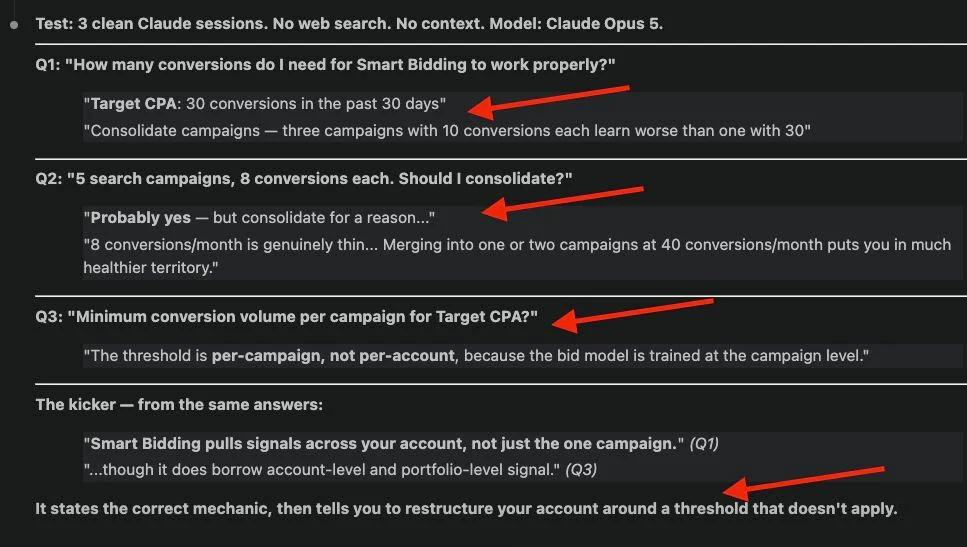
The common mistake is turning a useful volume benchmark into a false platform rule. In three clean AI sessions, I asked how many conversions Smart Bidding needs, whether five campaigns with eight conversions each should be consolidated, and whether Target CPA has a minimum per campaign. The answers repeatedly recommended consolidation around a 30-conversion threshold.
That advice sounds tidy. It is also incomplete.
The same answers acknowledged that Smart Bidding can use signals across an account, then claimed the bid model trains at the campaign level. Those statements conflict. Google’s own documentation says its bidding algorithms are not limited by where a keyword sits in the account structure.
| Claim | What Google documents | Better operating decision |
|---|---|---|
| Every campaign needs 30 monthly conversions | Smart Bidding uses query-level conversion data across campaigns | Judge signal quality, total relevant data, and business controls |
| Five low-volume campaigns should become one | Shared learning reduces data scarcity, but settings still differ by campaign | Consolidate only when the campaigns do not need separate control |
| Target CPA learns only from its campaign | Bids use auction-time context plus query-level performance across the account | Review bid strategy scope, goals, and conversion definitions together |
This is why generic AI advice is dangerous in a live ad account. The answer can sound precise while quietly inventing a rule Google does not state.
How Google Ads Smart Bidding actually learns
Google Ads Smart Bidding predicts the likelihood or value of a conversion for each auction, then sets a bid based on the strategy, target, budget, and available context. Device, location, time of day, audience membership, query, and other signals can all affect that prediction.
Google calls this auction-time bidding. The bid is not a static campaign average. It changes for the specific search and user context entering the auction.
The more important detail for account structure is query-level learning. Google’s Smart Bidding guide says the system uses search query-level conversion data across the account to solve data scarcity that individual keywords may face. Its technical explanation of automated bidding goes further: conversion data is used across ad groups and campaigns, and moving a keyword does not force the system to relearn a known query from scratch.
What query-level data means in plain language
A search query is the phrase a person actually typed. A keyword is the targeting instruction in your account that allowed an ad to enter the auction. Several keywords, ad groups, or campaigns can encounter similar queries.
If one campaign has little history for a query, Smart Bidding can use patterns from that query and similar traffic elsewhere in the account. Google also says low-data campaigns can start with broader query-level models and improve as more granular conversion data arrives.
Shared learning does not mean every campaign is interchangeable. It means “this campaign has only eight conversions” is not enough evidence to declare that its bidder cannot learn.
Does Smart Bidding require 30 conversions per campaign?
No current Google documentation establishes 30 monthly conversions per campaign as a universal technical requirement for Target CPA. Google does recommend evaluating performance over a period with enough conversions, and operators need enough signal to separate normal variation from a real pattern. That is different from saying each campaign is blind below 30.
TNT Growth uses practical volume floors when choosing a conversion action. For Search, our starting guardrail is roughly 15 conversions in 30 days for the event expected to steer bidding. PMax and Demand Gen generally need denser feedback because they operate across broader inventory. Our Google Ads conversion action guide explains those campaign-type guardrails.
These are operating judgments from scaled accounts, not secret Google requirements. Data quality, conversion delay, market size, sales cycle, value variance, and the depth of the event all matter.
A campaign with 12 clean SQLs can be more useful than one with 60 spam form fills. Counting conversions without checking what they represent misses the point of Smart Bidding.
When campaign consolidation helps
Campaign consolidation helps when several campaigns serve the same goal and their separation adds no useful control. Fewer campaigns can reduce operational clutter, simplify budgets, and make reporting easier to interpret.
Consolidation is usually reasonable when the campaigns share:
- The same conversion goal and qualification standard
- Similar customer economics and acceptable CPA
- The same geography, language, and schedule
- The same landing-page and offer strategy
- No real need for separate budgets or bid targets
In that situation, merging can improve management even if shared bidding data was already available.
A worked five-campaign example
Assume five Search campaigns each produce eight conversions per month. Together, they generate 40 conversions. An AI answer may tell you to merge them because each campaign sits below 30.
That recommendation is weak without context.
If the five campaigns cover the same product, geography, economics, and goal, consolidation may remove pointless boundaries. If they cover five regions with different sales capacity, five products with different margins, or brand and non-brand demand with different incrementality, merging can hide decisions the business still needs to make.
The right question is not “Will one campaign give Google more data?” The right question is “What control or insight would we lose by combining these campaigns?”
When not to consolidate campaigns
Do not merge campaigns just to satisfy a conversion-count rule. Keep campaigns separate when the business needs different budgets, targets, inventory, locations, compliance controls, or measurement.
| Keep campaigns separate when | Why it matters |
|---|---|
| Products have different margins or close rates | One blended Target CPA can overfund the weaker economics |
| Regions have different capacity or performance | A shared budget can starve a strategic market |
| Brand and non-brand traffic need separate reporting | Blended CPA can hide whether paid traffic created demand |
| Conversion goals differ | The bidder would receive mixed instructions about success |
| One campaign is testing a controlled change | Consolidation would destroy the comparison |
Also avoid restructuring during a tracking repair or bid-strategy transition. Google advises allowing time for algorithms to adjust after conversion-goal changes. Our Target CPA versus Target ROAS framework covers target selection, value quality, and conversion-cycle timing.
How to evaluate low-volume Smart Bidding safely
Low volume calls for better diagnosis, not automatic consolidation. Use this sequence before changing structure.
1. Verify the conversion action
Confirm the campaign is optimizing for a real business outcome. Check primary and secondary status, campaign-specific goals, duplicates, import health, attribution timing, and whether sales applies the qualification rule consistently.
2. Measure conversion delay
A campaign can look starved when recent conversions have not arrived yet. Review the lag from click to qualified event and compare complete cohorts. Google’s bid strategy report includes conversion-delay and top-signal information that helps with this review.
3. Review total relevant signal
Look beyond one campaign’s conversion count. Check whether the account has query history, whether a portfolio strategy spans campaigns, and whether the same conversion goal appears across related campaigns.
4. Inspect business differences
Write down why each campaign exists. If the answer is only “that is how the account was built,” consolidation may be overdue. If each campaign protects a real budget, target, geography, product, or experiment, keep the separation.
5. Change one major variable at a time
Do not change campaign structure, conversion goals, budgets, and Target CPA together. Hold unrelated controls steady for one or two conversion cycles. Our Google Ads campaign settings guide lists the settings that can quietly change what traffic enters and what outcome bidding pursues. If the controlled change is a deeper event, use this conversion-action testing sequence to build history, reset the target, and account for reporting lag.
6. Judge qualified outcomes
Evaluate cost per qualified lead, pipeline, customers, revenue, or another downstream result. Platform conversion volume is diagnostic evidence, not the final score.
The bigger lesson for AI advice in paid media
AI tools can summarize documentation and help operators inspect an account, but they should not be trusted with unsourced platform rules. A confident threshold, benchmark, or restructuring recommendation needs a source and an account-specific reason.
Ask three follow-up questions whenever an AI tool gives Google Ads advice:
- Is this a documented platform requirement or an operator benchmark?
- What account-level evidence would change the recommendation?
- What control, history, or measurement would be lost if we follow it?
This is the same boundary we use for a human-supervised Google Ads AI agent: the system can gather evidence and prepare a decision, but a named operator owns the account change.
The takeaway
Google Ads Smart Bidding uses auction-time context and query-level conversion data across campaigns. Campaign-level volume still matters as a diagnostic, but it is not a universal wall around the model. Consolidate campaigns when separation has no business purpose. Keep them separate when budgets, economics, goals, markets, or tests require control.
If your account structure was built around generic thresholds instead of qualified pipeline, TNT Growth can audit the signal, bidding, and campaign controls. Review our Google Ads and tracking services, see results tied to revenue, or book a strategy call.
Frequently asked questions
How many conversions does Google Ads Smart Bidding need?
Google does not publish one universal per-campaign minimum for Smart Bidding. Its systems use auction-time signals and query-level conversion data across campaigns. TNT Growth uses practical operating floors to judge whether a conversion action is stable enough, but those guardrails are not platform requirements and should not be used as automatic campaign-consolidation rules.
Does Smart Bidding learn across Google Ads campaigns?
Yes. Google says Smart Bidding uses search query-level conversion data across the account and is not limited by the ad group or campaign where a keyword lives. That shared learning helps with low-volume queries and new keywords. Campaign settings, goals, budgets, and data quality still affect performance, so shared learning does not make structure irrelevant.
Should low-volume Google Ads campaigns be consolidated?
Consolidate when campaigns do not need separate budgets, targets, locations, products, economics, or conversion goals. Do not merge them only to reach an assumed conversion threshold. First confirm that the campaigns serve the same business purpose and that consolidation will not hide meaningful differences in profitability or control.
Is 30 conversions per campaign required for Target CPA?
No universal 30-conversion per-campaign requirement appears in Google's current Smart Bidding guidance. Google recommends evaluating performance over periods with enough conversions, and account operators may use volume guardrails, but Smart Bidding also uses query-level data across campaigns. Treat 30 as a diagnostic benchmark in context, not a hard technical gate.
When should you avoid changing campaign structure?
Avoid structural changes when the account is still absorbing a new conversion goal, tracking repair, target change, budget change, or seasonal shift. Changing several controls together makes the result hard to interpret. Hold unrelated variables steady for at least one or two conversion cycles, then judge qualified outcomes rather than platform conversions alone.