
YouTube ads for B2B do not need studio production to prove they can work. Start with existing social videos, founder clips, screen recordings, or simple motion graphics. Test whether the hook attracts the right buyer, compare qualified CPA with Search, and invest in better production only after the concept produces repeatable business results.
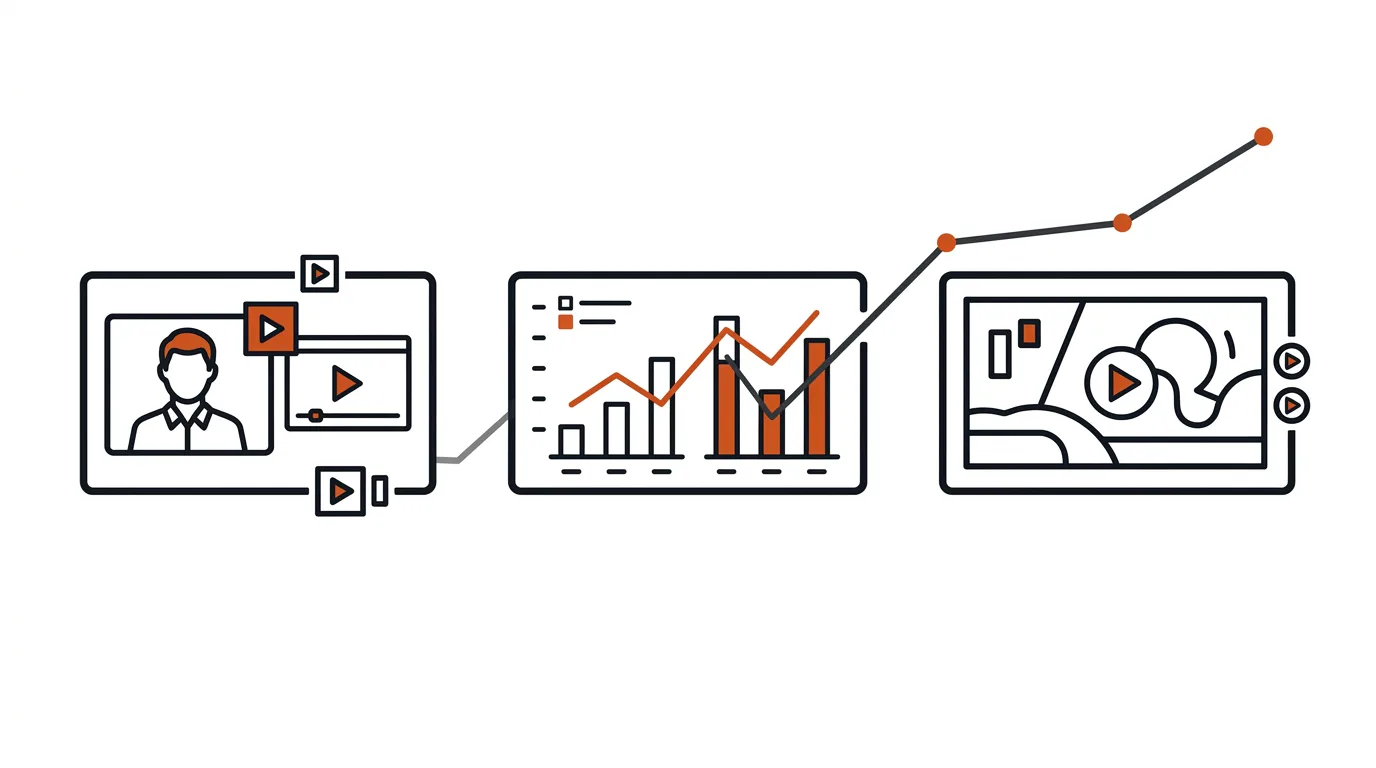
Why YouTube ads for B2B can start with simple creative
Simple creative lowers the cost of learning. A founder talking to camera, a screen recording, a repurposed Meta video, or a text-led animation can tell you whether the market responds to the problem, proof, and offer. That evidence is more valuable at the start than polish.
We have used this approach across accounts spending roughly $700K per month on YouTube and reached a 4x return on ad spend in the source example. Those numbers are observations from specific accounts, not guarantees. The repeatable lesson is the sequence: validate cheaply, prove the economics, then improve production around the concept that earned it.
Our guide to how YouTube ads actually work explains why the channel inherits Google Ads conversion data and often creates intent that Search captures later.
The three-stage B2B YouTube ads strategy
A useful B2B YouTube ads strategy separates creative validation from media validation and production. Combining all three into one expensive launch makes failure hard to diagnose. You will not know whether the problem was the hook, the audience, the conversion signal, the landing page, or the video itself.
| Stage | Question to answer | Creative | Main decision |
|---|---|---|---|
| 1. Validate cheaply | Does this message earn attention from the right buyer? | Existing social video, founder clip, screen recording, simple motion | Keep or kill the concept |
| 2. Prove economics | Can the concept produce qualified outcomes near the account target? | Winning low-cost edits in the required formats | Scale, revise, or stop spend |
| 3. Upgrade production | Is there enough evidence to fund a stronger execution? | Customer story, product film, documentary, polished series | Build around the proven angle |
Stage 1: validate with assets you already have
The first test should answer a narrow question: does this message create enough qualified interest to deserve another round? Pull the best-performing social videos, founder clips, customer proof, product walkthroughs, or slide-based explanations you already own.
Prepare each useful concept in horizontal, square, and vertical versions. Google currently recommends 16:9, 1:1, and 9:16 video assets for Performance Max, with at least 10 seconds for the common video placements. Its Performance Max video asset guidance also notes that Google may create videos automatically when an advertiser does not upload them. Supplying your own versions gives you more control over the message and visual quality.
A basic B2B ad can follow this structure:
- Pattern interrupt: Name a specific problem or result in the opening seconds.
- Recognition: Show that you understand why the buyer is stuck.
- Mechanism: Explain the process, product, or decision that changes the result.
- Proof: Use a verified number, customer result, or visible demonstration.
- Next step: Give one concrete action that matches the buyer’s stage.
If the first five seconds do not create a reason to continue, more production will not rescue the ad. Change the opening before rebuilding the whole piece.
Stage 2: compare qualified CPA, not cheap views
The second stage asks whether the campaign can produce a business result at an acceptable cost. Cost per view and CPM help diagnose delivery, but neither tells you whether a B2B buyer entered pipeline.
We compare YouTube with Search because Search provides an account-specific baseline for people who already state intent. The goal is not necessarily to beat Search CPA immediately. A useful validation band can be within 20 to 30 percent of Search CPA while producing consistent qualified conversion volume and evidence of assisted demand.
Use the same conversion definition across the comparison. A YouTube form fill cannot be compared honestly with a Search SQL. Connect both campaigns to the same qualified event, then review:
- Cost per qualified lead
- Cost per opportunity
- Pipeline and revenue per dollar spent
- Conversion lag
- Branded search and direct traffic after launch
- Assisted or view-through conversions
Google defines a view-through conversion as a conversion matched to an ad view when no higher-priority click or engaged view occurred within the selected window. Its Demand Gen view-through conversion documentation explains the reporting hierarchy and current eligibility. Treat that data as one part of the evidence, not as a replacement for CRM outcomes.
A worked validation scenario
Assume a B2B Search campaign produces qualified opportunities at a $400 CPA. The YouTube test uses three repurposed videos and enough monthly budget to support roughly 50 conversions at the expected platform CPA.
After a full conversion cycle, one creative produces qualified opportunities at $470. The other two land above $800 and show weak downstream quality. The answer is not “YouTube works” or “YouTube fails.” The answer is that one message is within 18 percent of the Search baseline and deserves controlled scaling, while the other concepts should stop.
Next, make two or three variations of the winner. Change the opening, proof point, or format while preserving the core argument. If those variations hold near the same qualified CPA, the concept is becoming repeatable. That is the evidence needed for the production stage.
Stage 3: upgrade the idea that already won
Better production should increase the range and durability of a proven concept. It can create a stronger customer story, a more useful demonstration, a documentary-style narrative, or a repeatable educational series. It should not be a substitute for evidence.
For YouTube, we commonly separate production into three length bands:
- 30 to 60 seconds: fast validation, a single problem, or a direct proof point
- 60 to 120 seconds: the core performance range for explanation and objection handling
- 2 to 5 minutes: education, customer stories, and higher-trust buying decisions
Google’s Demand Gen asset specifications show how video and image assets can serve across YouTube, Discover, Gmail, and other eligible inventory. Build the production plan around the placements you intend to use, rather than cutting one horizontal video after everything is finished.
What makes a simple YouTube ad effective
A simple ad works when it reduces the distance between the buyer’s problem and the proof. It fails when “authentic” becomes an excuse for vague positioning, slow pacing, or a weak offer.
A useful opening is specific
“Lower your Google Ads CPA” is broad. “Your PMax campaign is optimizing for booked calls that never show up” names a mechanism and a failure mode. The second version gives the right operator a reason to listen.
The ad shows proof early
For a service business, proof might be a real before-and-after metric, a cropped account view, a customer quote with permission, or a short screen recording of the workflow. For software, show the product completing the task. Do not spend 30 seconds introducing the company before the buyer sees why the claim is credible.
The landing page continues the same argument
If the ad discusses qualified pipeline and the landing page opens with generic brand copy, the message breaks at the click. Match the page headline, proof, and CTA to the video concept. TNT Growth tests paid-media creative and landing pages together because the ad cannot compensate for a page that changes the subject.
Common B2B YouTube ads mistakes
Most failed tests are not proof that the channel cannot work. They are tests that never isolated the real variable.
| Mistake | What goes wrong | Better approach |
|---|---|---|
| Paying for a large production before testing | One expensive concept carries all the risk | Test several low-cost messages first |
| Optimizing to a shallow form fill | The campaign learns to find cheap, low-quality actions | Send qualified CRM events back to Google |
| Comparing YouTube views with Search customers | Different outcomes make the channel comparison meaningless | Use the same down-funnel conversion goal |
| Launching one aspect ratio | The ad cannot fit important YouTube inventory cleanly | Supply horizontal, square, and vertical assets |
| Changing budget, audience, creative, and bidding together | No one can explain the result | Change one major variable per test cycle |
| Upgrading production after one lucky week | The team scales noise instead of a repeatable concept | Confirm the winner across variants and conversion lag |
Our YouTube ads benchmarks provide the 70/20/10 testing model, format ranges, and monthly review process for campaigns that move beyond initial validation.
When not to run this playbook
Do not scale a B2B YouTube test when conversion tracking is incomplete, the CRM cannot identify qualified outcomes, the budget cannot survive a full conversion cycle, or the team has no capacity to make variations. In those cases, simple creative produces faster confusion, not faster learning.
You may also need to wait when Search has not established any useful signal. YouTube can benefit from the conversion history already inside Google Ads. If the account does not know who becomes a customer, opening more inventory gives the system more ways to guess.
For campaigns using Google’s broader inventory, run the Google Demand Gen checklist before increasing spend. It covers asset variety, view-through tracking, audience structure, conversion floors, and bad-lead retractions.
How to run the test yourself
A practical launch can fit into seven steps:
- Pick one audience and one business problem.
- Pull three to five existing video or motion assets that address it.
- Cut each viable concept into 16:9, 1:1, and 9:16 versions.
- Confirm the campaign receives the same qualified conversion event as Search.
- Set enough budget and time to reach a meaningful sample through conversion lag.
- Compare qualified CPA, pipeline, and lift, then kill weak concepts.
- Build variations of the winner before approving higher production spend.
Log the hook, audience, proof, format, spend, qualified conversions, CPA, and decision so the next creative choice is clear.
The takeaway
YouTube ads for B2B are easier to test than most teams make them. Start with existing creative, but give each ad a specific buyer problem, visible proof, and one next step. Compare qualified CPA with Search, account for assisted demand, and require a concept to repeat before spending on better production.
Production value can improve a working ad. It cannot tell you which message deserved to be made.
TNT Growth manages Google Ads, YouTube, conversion tracking, and landing-page testing for scaled accounts. Explore our paid-media services, see client results, or book a 30-minute ad audit to map the first B2B YouTube test.
Frequently asked questions
Do YouTube ads work for B2B companies?
Yes, YouTube ads can work for B2B companies when the campaign has a clear audience, reliable conversion tracking, enough budget to generate a useful sample, and creative that names a real buyer problem quickly. Judge the test on qualified CPA, pipeline, revenue, and measured lift, not views alone.
Do B2B YouTube ads need high production value?
No. Repurposed social videos, founder clips, screen recordings, simple motion graphics, and slide-based explainers are enough to validate a hook and offer. Higher production makes sense after a concept proves it can attract qualified buyers at an acceptable cost.
How much budget should a B2B YouTube ads test use?
Set a budget that can support about 50 conversions per month using the account's existing Search CPA as the starting assumption. That is TNT Growth's operator guideline, not a Google requirement. High-ticket accounts with lower conversion volume may need a longer test and stronger assisted-conversion measurement.
Should YouTube ads be compared with Meta or Google Search?
For a Google Ads account, compare YouTube with Search on the same qualified conversion goal. Search provides a useful account-specific economic baseline and often captures demand that YouTube helped create. A Meta comparison can add context, but it should not replace the Search and CRM view.
When should a company invest in better YouTube production?
Upgrade production after a low-cost version proves the hook, audience, offer, and conversion path. Look for repeatable qualified CPA, stable conversion volume, and evidence that the same concept works across more than one edit or format. Production should scale a validated idea, not hide an untested one.