
To scale Meta ads, use three different growth paths: increase budget on proven ads, launch new message angles for different buyer motivations, and adapt winning messages into new formats. Budget alone usually reaches a limit. Sustainable scaling gives Meta more ways to find a response while keeping cost per customer under control.
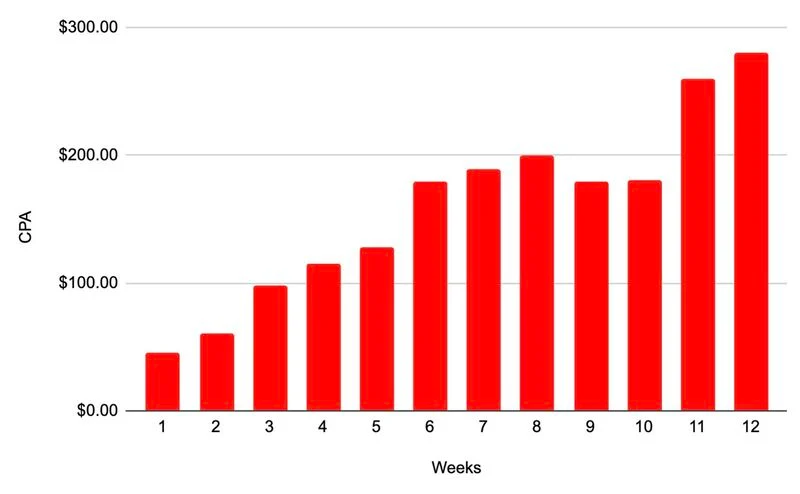
Most teams discover a winning ad, increase the budget, and call that scaling. The approach works until the same audience sees the same message too often. Frequency climbs, the ad loses its effect, and cost per customer rises even though the creative once looked like a winner.
That does not mean the market is exhausted. It often means the account has exhausted one message and one format. The fix is to separate scaling into vertical, horizontal, and diagonal moves.
How to scale Meta ads with three growth paths
Meta ads can scale in three ways. Vertical scaling increases spend on what already works. Horizontal scaling changes the message to reach a different motivation. Diagonal scaling changes the format so the same message can work in different placements and consumption habits.
| Scaling path | What changes | What stays stable | Main risk |
|---|---|---|---|
| Vertical | Budget | Message, format, offer | Frequency and CPA rise |
| Horizontal | Buyer motivation and angle | Product and core offer | Angles are too similar to reach new response |
| Diagonal | Creative format and placement fit | Winning message | Repurposed assets feel unnatural in the new format |
These paths solve different constraints. A budget problem needs vertical room. A message problem needs horizontal range. A format problem needs diagonal coverage. Treating every plateau as a budget problem is how teams burn out their best ads.
1. Vertical scaling increases budget on proven ads
Vertical scaling is the simplest method: put more money behind an ad set or campaign that already produces acceptable economics. It should usually be the first scaling move because it requires no new concept or production work.
It is also the first method to break. The reachable audience is finite, and more budget can increase how often the same people see the same creative. Meta defines frequency as impressions divided by reach. Its frequency guidance recommends monitoring frequency alongside results and ad relevance diagnostics. If performance falls as frequency rises, the audience may be experiencing ad fatigue.
Do not treat a specific frequency number as a universal stop signal. A purchase with a long consideration cycle may need more exposures than an impulse product. Retargeting also behaves differently from broad prospecting. Use frequency as a diagnostic paired with business results.
How to increase budget safely
- Confirm that the result is profitable using site, CRM, and revenue data.
- Check whether performance depends on one ad, one audience pocket, or one short period.
- Increase budget in controlled steps rather than making several major edits together.
- Watch cost per customer, qualified lead rate, reach, and frequency.
- Stop increasing spend when marginal economics break, even if total volume rises.
A campaign is not scaling well because it spends more. It is scaling well when the next dollar still produces an acceptable business outcome.
2. Horizontal scaling changes the message angle
Horizontal scaling creates new messages for different buyer motivations. It does not mean changing one headline, button color, or opening sentence. It means giving a different type of buyer a reason to care.
A productivity product might start with an efficiency angle such as “save ten hours a week.” That message can work for buyers who value time. It may do nothing for buyers motivated by recognition, competitive pressure, certainty, control, or team performance.
The horizontal move is to build a new concept around another motivation:
| Buyer motivation | Example angle | What the buyer wants |
|---|---|---|
| Efficiency | Save ten hours each week | More output with less time |
| Status | Make your team look prepared in every meeting | Recognition and confidence |
| Competitive pressure | Stop giving competitors the response-time advantage | Protection from losing ground |
| Risk reduction | Catch costly errors before they reach a client | Fewer bad surprises |
| Control | See every stage and owner in one place | Clarity over the process |
Each angle should have its own claim, proof, visual idea, and opening hook. If only the headline changes while the visual and promise remain the same, the account has created a variation, not a new route to demand.
Meta makes the same distinction in its guidance on creative diversification. Minor iterations refine an existing idea. True diversification creates materially different assets for different personas, use cases, or contexts, which gives the delivery system more opportunities to find incremental audiences.
In the source example, each distinct angle could support about $50,000 per month without competing for exactly the same response. That is an operator example, not a platform benchmark. The actual capacity depends on market size, economics, geography, and offer strength.
3. Diagonal scaling changes the creative format
Diagonal scaling takes a message that already works and expresses it in formats that fit different placements and viewing habits. Some people stop for static images. Some watch Reels. Some trust a founder speaking to camera. Others respond to a customer demonstration or product walkthrough.
A useful format matrix includes:
- Static image with one clear claim
- Short motion graphic that explains the mechanism
- User-generated or customer-style video
- Founder-led video with a direct operator point of view
The format should change how the idea is experienced, not simply resize the same file. A static ad needs immediate visual hierarchy. A Reel needs a strong opening frame and vertical composition. A founder video needs a credible point.
Diagonal scaling can rescue a proven message that has plateaued in one placement. The claim may still be strong, but the account has not packaged it for the next audience.
How motivator mapping creates better horizontal tests
Motivator mapping is a simple way to avoid making five versions of the same ad. Start with the buyer’s job, then list the different reasons that person would care about solving it.
For each motivation, answer four questions:
- What does the buyer want to gain or avoid?
- What specific claim addresses that motivation?
- What proof makes the claim credible?
- What visual scene makes the motivation obvious before the copy is read?
Imagine a reporting platform for marketing leaders. One buyer wants faster reporting. Another wants confidence before a board meeting. A third wants to catch wasted spend. A fourth wants to prove marketing’s effect on revenue. Those are four creative territories, not four synonyms for “better analytics.”
The test becomes more useful because each result teaches you which motivation moves the market. If the risk-reduction angle wins, the next round can deepen that territory with different proof and formats. If every angle says “save time,” a winner only proves that one wording beat another.
A practical Meta creative scaling plan
Use a sequence that isolates the constraint before adding complexity.
Phase 1: Prove one message
Launch a small set of distinct concepts around the strongest known buyer problems. Keep the offer and landing page stable. Look for a concept that produces acceptable downstream economics, not simply the lowest click cost.
Phase 2: Scale vertically until marginal performance breaks
Increase spend while monitoring frequency, reach, cost per customer, and lead quality. Document the point where added spend stops producing acceptable returns. That is the current vertical ceiling, not a permanent account ceiling.
Phase 3: Add horizontal angles
Use motivator mapping to create concepts for buyers who did not respond to the first message. Give each angle enough visual and verbal difference to stand on its own. Avoid launching ten tiny variations that divide the budget without expanding the account’s learning.
Phase 4: Expand winning angles diagonally
Take each proven message into static, motion, customer-style, and founder-led formats. Build for the placement rather than cropping after production. Compare results by angle and format so the team knows whether the message or execution drove the change.
Phase 5: Refresh before the account is desperate
Create the next concepts while the current winners still work. Waiting for a sharp CPA spike forces the team to rush, and rushed production usually produces cosmetic changes instead of new ideas.
Common Meta ads scaling mistakes
Scaling usually fails because the team confuses more activity with more market coverage.
| Mistake | Why it fails | Better move |
|---|---|---|
| Doubling budget on one winner | Reaches the same audience more often | Add a new message angle before saturation |
| Testing minor copy edits only | Does not create a distinct buyer reason | Change the motivation, proof, and visual concept |
| Resizing one asset for every placement | Ignores how people consume each format | Rebuild the idea for static, Reels, and founder video |
| Judging on platform CPA alone | Can hide weak lead quality or revenue | Reconcile with site and CRM outcomes |
| Changing budget, audience, offer, and creative together | Makes the result impossible to explain | Change one major variable per test |
| Refreshing only after performance collapses | Leaves no proven replacement ready | Keep the next concept batch in production |
Our marketing funnel analysis framework helps separate a creative problem from an audience, auction, site, tracking, or sales problem before the team replaces ads that were not the cause.
When not to scale Meta ads
Do not scale a campaign simply because Meta reports a low cost per result. First confirm that the event matches a real business outcome and that the result holds outside the platform’s own attribution view.
Pause the scaling plan when:
- Conversion tracking is incomplete or duplicated.
- Lead quality is unknown or falling.
- The offer has not produced repeatable sales.
- One creative carries nearly all performance.
- Frequency rises while cost per customer worsens.
- The landing page cannot convert additional traffic.
- The team cannot produce materially different concepts.
More budget magnifies what already exists. If the signal, offer, or funnel is weak, scaling spends faster without fixing the constraint.
The takeaway
Learning how to scale Meta ads starts with separating budget, message, and format. Increase spend while the economics hold. When the same ad reaches its ceiling, open a new buyer motivation. When the message works but placement coverage is thin, rebuild it in formats suited to how people consume the feed.
The strongest accounts do not depend on one winner. They build a repeatable system that discovers messages, proves them with real business outcomes, and gives each winning idea more than one way to reach the market.
TNT Growth plans and manages paid acquisition for B2B brands that need growth tied to CRM and revenue outcomes. Review our paid acquisition services or book a 30-minute ad audit to find whether budget, message, format, or measurement is limiting your next stage of growth.
Frequently asked questions
How do you scale Meta ads without raising CPA?
Scale Meta ads through a mix of controlled budget increases, new message angles, and new creative formats. Watch frequency and cost per customer as spend rises. When the same audience sees the same ad repeatedly and performance falls, stop forcing budget through that asset and open a new path to reach buyers.
What is horizontal scaling in Meta ads?
Horizontal scaling means launching distinct message angles that appeal to different buyer motivations. An efficiency message, a status message, and a competitive message can reach different people even when the product and offer stay the same. The goal is new audience response, not minor copy variations on one concept.
What is vertical scaling in Meta ads?
Vertical scaling means increasing spend on an ad or campaign that already works. It is the simplest scaling method, but it often breaks first because frequency rises, the reachable audience saturates, and cost per customer climbs. Increase budgets in controlled steps and judge downstream economics, not spend or platform conversions alone.
How can creative fatigue be fixed on Meta ads?
Fix creative fatigue by identifying whether the problem is the message, the format, or both. Build new concepts for different buyer motivations, then express proven messages as static, motion, UGC, founder-led, and placement-native assets. A cosmetic edit to the same ad is less likely to reach a genuinely new response pattern.
When should you not scale a Meta campaign?
Do not scale when conversion tracking is unreliable, lead quality is unclear, the offer is unproven, or the current campaign only looks profitable inside Meta's reporting. Confirm site and CRM outcomes first. More budget multiplies the strengths and weaknesses already present in the system.