
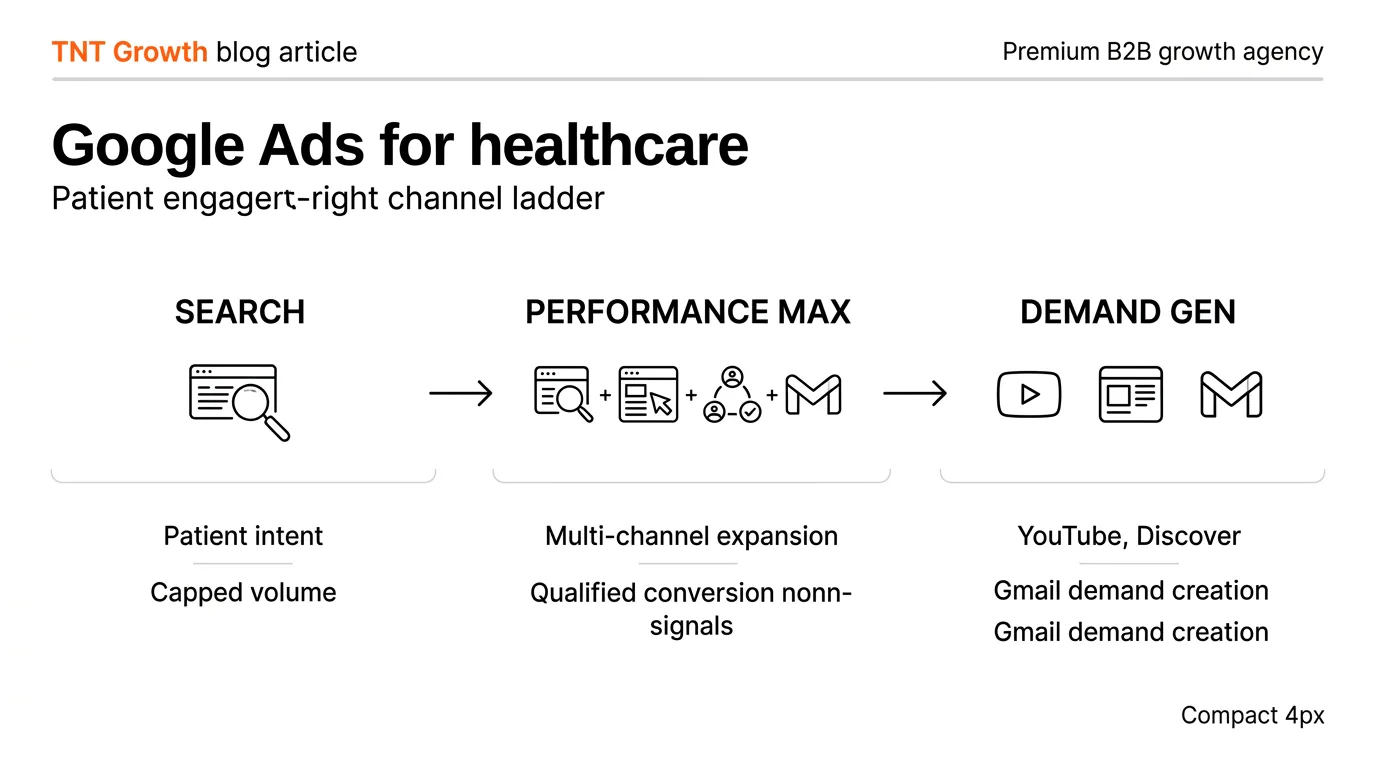
Google Ads for healthcare should scale in three stages. Start with Search to capture explicit patient intent. Add Performance Max after the account produces enough clean, qualified conversions for automation to learn. Add Demand Gen when you need to reach future patients before they search. Each stage needs its own signal, budget, creative, and compliance controls.
Why healthcare Google Ads hit a Search ceiling
Healthcare PPC often begins with Search because it captures people who state their need directly. A patient searches for a service, treatment, provider, or location, and the advertiser can match the query with a relevant ad and page. That intent is valuable, which is also why the inventory becomes expensive.
On scaled healthcare accounts, we often see core patient-intent impression share approach roughly 80 percent. Cost per click can rise 15 to 25 percent month over month as more budget competes for the same finite searches. Those figures are operator observations from the source account set, not universal platform benchmarks. The pattern matters more than the exact number: Search eventually runs out of efficient auctions.
Three stages solve different constraints:
| Stage | Job | Launch condition | Main risk |
|---|---|---|---|
| Search | Capture existing patient intent | Clear query demand and compliant landing pages | Bid inflation and finite volume |
| Performance Max | Find additional qualified demand across Google | Stable Search plus clean downstream conversion data | Cheap but weak leads from broad inventory |
| Demand Gen | Create demand before the patient searches | Enough signal, creative, and measurement to judge assisted impact | Low-intent reach mistaken for acquisition |
The mistake is treating the stages as substitutes. Search is the foundation. PMax expands beyond the operator’s keyword list. Demand Gen reaches people earlier through visual inventory.
Check healthcare advertising policy before scaling
Healthcare advertising rules can change what you are allowed to promote, where ads can run, and whether certification is required. Google’s Healthcare and medicines policy says some content cannot be advertised, while other services can run only in approved locations and by certified advertisers.
Before launch, identify the exact service, target geography, and certification category. Addiction services, telemedicine, prescription drug services, health insurance, and other regulated areas can have different requirements. A campaign marked Eligible (limited) may be following a policy restriction rather than suffering from a bidding problem.
Do not try to optimize around a compliance issue. Confirm certification, destination content, location rules, and required disclosures before diagnosing delivery.
Stage 1: use Search to capture patient intent
Search should usually carry the first healthcare Google Ads budget because it gives the operator the clearest control over queries, geography, ad copy, and landing pages. Build around the services and locations patients actually search, then separate materially different intents so budgets and messages remain clear.
A practical Search foundation includes:
- Exact and phrase match for core themes. Start with the clearest service and location intent. Add broader matching after conversion tracking proves which patients become qualified.
- Geographic structure that reflects operations. Separate markets when patient economics, capacity, service availability, or regulations differ.
- Down-funnel conversion actions. Optimize toward qualified calls, attended appointments, verified insurance steps, admitted patients, or another outcome that reflects the business.
- Weekly search-term reviews. Remove jobs, education, research, DIY, unrelated conditions, and other queries that cannot become patients.
- Landing pages aligned to the query. A service and location promise in the ad should continue on the page.
Search Lost IS from budget shows how often eligible ads missed an impression because the budget was insufficient. Search Lost IS from rank shows missed impressions caused by Ad Rank. Use both before deciding whether to raise budget, adjust bids, improve relevance, or expand targeting.
How to know Search is near its efficient ceiling
Search is near its ceiling when the account captures most profitable core impressions, additional budget raises CPC faster than qualified patient volume, and expansion into broader queries weakens downstream quality. Do not use impression share alone. A campaign can have room to spend on queries that the business should not buy.
Before adding another campaign type, confirm the Search structure, negatives, conversion actions, and landing pages are stable. The Google Ads optimization matrix helps separate a real inventory ceiling from a quality or targeting problem.
Stage 2: add Performance Max after the signal is ready
Performance Max can expand healthcare PPC across Search, YouTube, Display, Discover, Gmail, Maps, and other Google inventory. That reach is useful only when the campaign receives clean information about which leads become real patients.
Google’s Performance Max lead-generation guidance recommends accurate conversion tracking, valuable lead goals, deeper funnel actions where possible, and realistic targets. That matches what we see in healthcare accounts. If you optimize for raw form fills, PMax can find cheap form fills. If you send qualified calls or attended appointments, it has a better definition of success.
TNT Growth generally waits for about 30 qualified conversions per month before launching PMax and prefers 50 or more before scaling it aggressively. These are operating guardrails, not guarantees. The quality and consistency of the event matter as much as the count.
A healthcare PMax readiness checklist
Launch only when these statements are true:
- Search produces a stable base of qualified conversions.
- Google Ads and the CRM reconcile within a known tolerance.
- The primary action represents a meaningful patient step.
- Spam, duplicates, no-shows, and disqualified leads can be retracted.
- Location, brand, URL, asset, and audience controls have been reviewed.
- The budget can run through at least one or two conversion cycles without daily changes.
Our Performance Max versus Search analysis includes a healthcare account where PMax ran around $150 CPA against roughly $664 from Search on the same goal. That does not make PMax universally better. It shows what can happen when dense conversion signal and expensive Search inventory create the right conditions.
What to watch after launch
Compare PMax and Search on the same qualified outcome. Review channel performance, search-term insights, new-customer reporting, and CRM quality. If PMax reports a lower CPA but produces fewer attended appointments or admitted patients, the apparent gain is not real.
Do not increase budget simply because the first week looks cheap. Healthcare conversion cycles can delay the evidence you need. Let outcomes bake, then judge qualified CPA or revenue.
Stage 3: use Demand Gen to create future patient demand
Demand Gen is the third stage because it reaches people before they type a high-intent search. Google’s Demand Gen overview describes inventory across YouTube, Discover, Gmail, Maps, and the Google Display Network, with more control over visual placements and audience segments than PMax.
That makes Demand Gen useful when Search and PMax are stable but the account still needs more qualified demand. It can educate people about symptoms, services, care options, outcomes, or provider differentiation before a direct search happens.
The campaign needs creative that fits the patient’s decision stage. Educational videos, clinician explanations, patient stories used with proper consent, service walkthroughs, and location-specific information can build understanding. Avoid fear-based claims, unsupported outcomes, and creative that conflicts with policy or applicable privacy rules.
How to launch healthcare Demand Gen
Use qualified Search terms and first-party data to build audience themes. Provide both image and video assets. Track view-through behavior without treating every view as a patient. Start with a realistic target and enough daily budget to collect conversions. Retract weak leads quickly because the audience pool is broader.
Our Google Demand Gen checklist covers 11 launch controls, including audience structure, asset variety, view-through tracking, device segmentation, conversion floors, and lead retractions.
Worked example: scaling from $10K to $95K per month
Across healthcare accounts we manage, one example scaled from roughly $10K per month to more than $95K per month while CPCs remained stable. The growth did not come from forcing more money into the same Search keywords. It came from sequencing channels around signal quality. Our Google Ads case studies show three additional healthcare examples built around qualified events, shared budgets, and landing-page message match.
| Phase | Account focus | What had to be true |
|---|---|---|
| Foundation | Exact and phrase Search around patient intent | Correct policy status, clean tracking, useful landing pages |
| Expansion | PMax added on qualified downstream events | Enough monthly conversions and CRM feedback |
| Demand creation | Demand Gen video and audience testing | Creative volume, view-through measurement, patient-quality review |
This is the safer way to scale. Each new stage earns its budget by proving downstream quality instead of borrowing credibility from the Search campaign.
Common healthcare PPC scaling mistakes
The first mistake is launching every campaign type at once. When Search, PMax, and Demand Gen all start together, there is no stable baseline and little useful conversion history.
Other failures include optimizing to raw form fills, ignoring call quality, mixing every location into one structure, increasing budgets during a capacity constraint, using one generic landing page for every service, and treating policy-limited delivery as a bid problem.
Healthcare also has an operational edge case that ad platforms cannot see. If a location has no appointment capacity, the campaign may still report efficient leads while the business cannot serve them. Feed capacity, payer fit, service availability, and sales or intake outcomes into budget decisions. Audit the full phone path with our healthcare call tracking guide so qualified demand does not disappear through lost attribution or misrouting.
How to run this healthcare Google Ads plan
- Confirm policy eligibility and required certification for the service and locations.
- Build Search around the highest-value patient-intent themes.
- Connect calls, forms, appointments, and downstream patient outcomes to the CRM.
- Select the deepest conversion action with enough monthly volume.
- Scale Search until qualified demand approaches its efficient ceiling.
- Add PMax at a controlled budget and compare it on the same outcome.
- Add Demand Gen after creative, audience, and view-through measurement are ready.
- Review qualified patient cost, revenue, and capacity by channel every week.
- Retract spam, duplicates, no-shows, and disqualified leads quickly.
- Move budget toward the stage producing incremental qualified demand.
The takeaway
Google Ads for healthcare scale through a sequence, not one campaign setting. Search captures existing patient intent. Performance Max finds additional qualified demand after the signal is dense and clean. Demand Gen creates future demand through visual inventory. Protect compliance, optimize toward patient outcomes, and make each stage prove downstream quality before it receives more budget.
TNT Growth runs healthcare Google Ads, conversion tracking, and landing-page testing for scaled teams. Review our healthcare and paid-media services, see client results, explore the $1M per month rehab marketing stack, or book a call to map the next stage of your account.
Frequently asked questions
Do Google Ads work for healthcare?
Yes, when the campaign targets allowed services, follows location-specific policy and certification rules, and optimizes toward qualified patient outcomes. Search is usually the starting point because it captures explicit intent. Performance Max and Demand Gen can add scale after tracking, conversion volume, creative, and compliance controls are strong.
Which Google Ads campaign is best for healthcare?
Start with Search when patients actively look for the service. Add Performance Max after Search produces a stable base of qualified conversions and the CRM sends reliable downstream outcomes. Add Demand Gen when the account needs to create demand through YouTube, Discover, Gmail, and other visual inventory rather than capture existing searches only.
How much conversion volume does healthcare PMax need?
TNT Growth generally wants about 30 qualified conversions per month before launching PMax and closer to 50 before scaling it aggressively. Those are operator guardrails, not universal Google requirements. The event also needs to represent a real patient outcome, such as a qualified call, attended appointment, or verified insurance action.
Are healthcare Google Ads restricted?
Some healthcare products and services are restricted by content type, target location, advertiser certification, or third-party accreditation. Requirements vary by service and geography. Review Google's Healthcare and medicines policy before launch, complete the correct certification process, and make sure the ad and destination follow applicable laws and platform rules.