
Are branded Google Ads keywords actually worth the money? We spent $40.4k over 6 weeks to find out on one account. Tripling brand spend drove 2,500 more paid clicks but cost 5,000 organic clicks, a net loss of 2,500 clicks. Most of the “extra” conversions would have happened anyway. Here is the full test and how to run it on your own account.
The question every brand campaign should have to answer
“Brand keywords are a waste of money” is one of the loudest debates in paid search, and most people argue it with opinions instead of data. When someone already searches your brand name, are you paying to capture a click you would have won for free through organic? Or is that spend genuinely bringing in customers you would otherwise lose?
We wanted three specific answers on this account:
- What is the optimal amount to spend on brand?
- Is Google Ads taking more credit than it should?
- Could we spend more on brand and drive incremental revenue?
So we ran a controlled, staged spend test rather than guessing.
How we structured the $40.4k test
We ran a 6-week test in three stages, stepping spend up at each stage so we could compare what happened to total traffic.
| Stage | Weeks | Weekly brand spend |
|---|---|---|
| Baseline | Weeks 1-2 | ~$1.5k to $2.2k |
| Test 1 (~3x baseline) | Weeks 3-5 | ~$6.5k to $7.5k |
| Test 2 (~11x baseline) | Week 6 | ~$16k |
The design matters. By holding a clean baseline first, then stepping up, we could isolate how many clicks each extra dollar of paid spend truly added, after accounting for the organic clicks that paid spend cannibalized.
How we measured it
Isolating incrementality is all about layering paid and organic data at the same time.
- Layered all the data. We exported branded clicks from Google Search Console weekly, and branded spend, clicks, and conversions from Google Ads weekly. Then we built a table for every week so paid gains and organic losses sat side by side.
- Compared time buckets. We averaged weekly stats for the Baseline, Test 1, and Test 2 periods. As paid spend rose, organic clicks fell. The real question was how many net incremental clicks remained after that organic drop.
The results
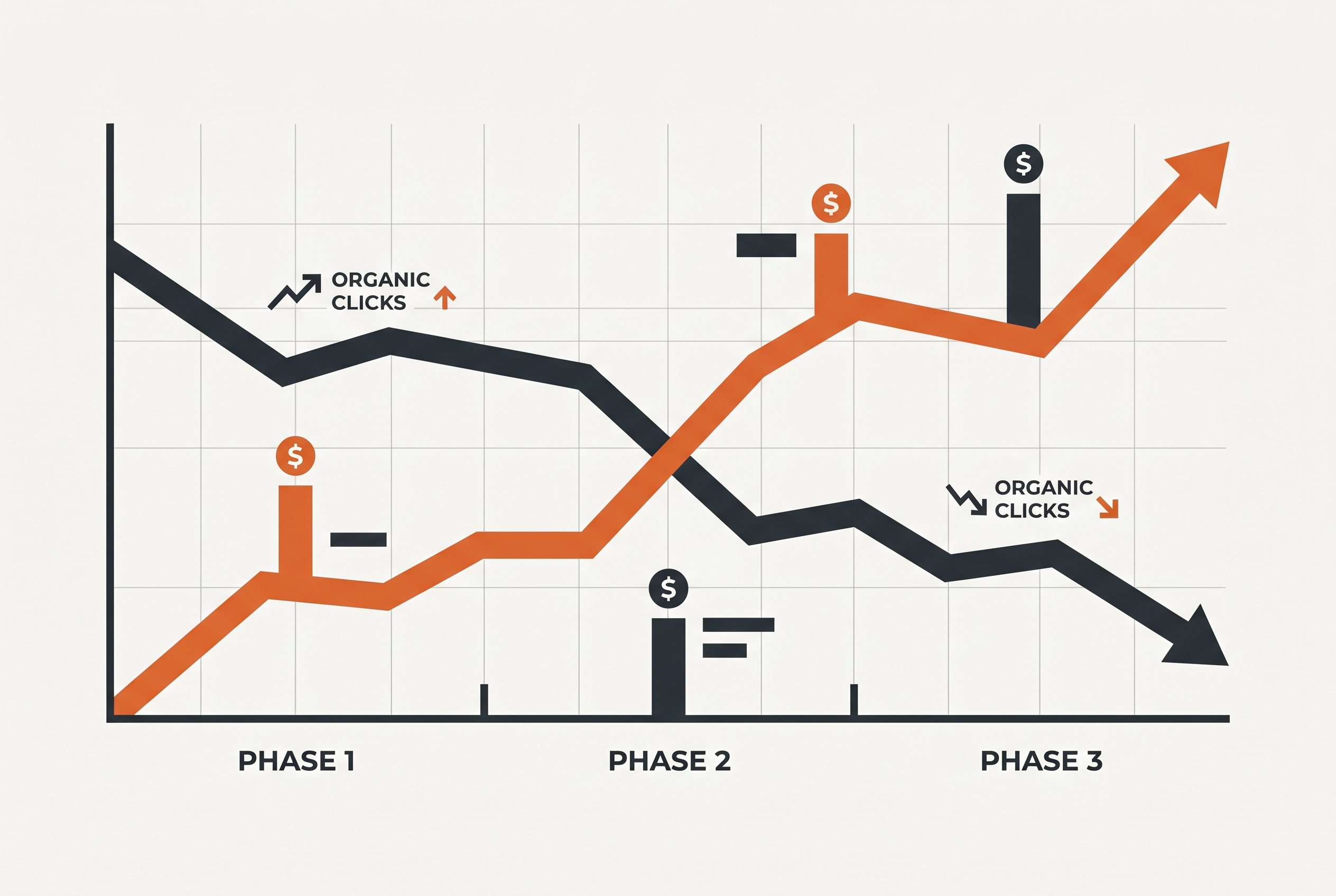
The data was blunt. More brand spend mostly ate our own organic traffic.
| Comparison | Extra weekly spend | Paid clicks gained | Organic clicks lost | Net clicks |
|---|---|---|---|---|
| Test 1 vs Baseline (~3x) | ~$5.5k | +2,500 | -5,000 | -2,500 |
| Test 2 vs Test 1 (~2x) | ~$9.1k | +1,000 | -850 | +150 |
At 3x baseline, we paid about $5,500 more per week and ended up with fewer total clicks. That is loss-making, not incremental. At Test 2, spending roughly $9,100 more per week netted only 150 extra clicks, which works out to a roughly 62x worse incremental CPA.
Every time we increased brand spend, we ate into organic traffic. Most of the extra conversions would have happened anyway. We were paying to intercept traffic we already owned.
What we did with the finding
Dropping brand spend from $16k/week back to $2k/week feels drastic, and it raises fair worries:
- Will competitors steal our traffic if we stop bidding?
- Will our brand lose surface area on the results page?
- Does losing brand clicks mean losing customers?
Those are real risks, and they are exactly why this is a test and not a blanket rule. But on this account the data was clear: the extra spend was not incremental. So we reallocated roughly $14k/week into generating net new demand, where it could actually bring in customers we did not already have. That is the same demand-creation logic behind how YouTube ads actually work as a top-of-funnel channel.
Why this depends on clean tracking
A test like this is only as trustworthy as the data underneath it. If your conversion tracking double-counts, misattributes, or misses organic entirely, your incrementality read is garbage. Getting branded paid and organic data to reconcile week over week is the same discipline as proper server-side conversion tracking: clean inputs first, decisions second.
It also pairs with feeding the algorithm the right signal elsewhere in the account. Once you free up brand budget, the win is spending it where you can prove incrementality, which comes back to scaling on deep, down-funnel conversions rather than cheap clicks.
For the measurement side, Google’s own guidance on conversion attribution and Search Console’s branded query data are the authoritative references to build your table from.
Run this test yourself
Every brand running Google Ads should run this test roughly every 4 months to check they are not wasting spend. We have run it across multiple accounts and the results always vary, sometimes the answer is spend more, sometimes spend less. The steps:
- Hold a clean 2-week baseline.
- Step spend to about 3x for 3 weeks, then spike to roughly 8x to 11x for a final week.
- Export branded paid and organic clicks weekly and lay them in one table.
- Compare paid clicks gained against organic clicks lost to find the truly incremental clicks.
- Reallocate any non-incremental spend into net new demand.
The takeaway
Brand keywords are not automatically a waste, and they are not automatically sacred. They are an assumption you can measure. On this account, tripling brand spend lost us traffic on net, so we moved the budget to demand generation. Run the test on your own account before you defend or cut your brand line, because the only honest answer comes from your data.
If you want a team that runs incrementality tests like this across millions in monthly spend, TNT Growth manages full-stack Google Ads for brands spending $50k+/mo. See our results or book a call and we will show you where your spend is not incremental.
Frequently asked questions
Are branded Google Ads keywords incremental?
Often not. In our 6-week, $40.4k test, tripling branded spend produced 2,500 more paid clicks but cost 5,000 organic clicks, a net loss of 2,500 clicks. Most of the extra conversions would have happened anyway through organic. Incrementality varies by account, which is why you have to test rather than assume.
How do you run a brand keyword incrementality test?
Run a staged spend test over about 6 weeks. Set a low baseline for 2 weeks, roughly triple it for 3 weeks, then spike it for the final week. Each week, export branded clicks from Search Console and branded spend, clicks, and conversions from Google Ads, then compare paid gains against organic losses to isolate the truly incremental clicks.
Should you turn off brand keywords entirely?
Not automatically. Brand campaigns still defend against competitors bidding on your name, control the message on high-intent searches, and can be incremental in some accounts. The point of the test is to size how much of your brand spend is truly incremental so you can right-size it, not to blindly switch it off.
How often should you re-run a brand incrementality test?
About every 4 months. Competitor bidding, organic ranking changes, and seasonality all shift how incremental your brand spend is. We have run this test across multiple accounts and the answer varies each time, sometimes spend more, sometimes spend less, so it is worth repeating.